"TEKERE TALKS!"

"Cde Edgar Tekere has opened a can of worms and we need to study those worms!" For the other blogs by Rev M S Hove, please kindly click on "View my complete profile" below!

ROBERT NESTER MARLEY!!!

Loading...

UK Web Hosting
pollcode.com free polls
Who do you believe wanted to assassinate the Tsvangirais?
Robert Mugabe and ZANU-PF! Other forces..... you can give comment! No-one.... just pure accident!   

"MY WIFE YOU HURT ME!!!" REV M S HOVE

"MY WIFE YOU HURT ME!!!" REV M S HOVE
PLEASE CLICK ON IMAGE TO GET TO ARTICLE!!
Custom Search

THE FULL LETTER FROM DR J M NKOMO TO THEN PM RG MUGABE!!!

THE FULL LETTER FROM DR J M NKOMO TO THEN PM RG MUGABE!!!
PLEASE CLICK ON IMAGE TO GO TO LINK!!!!

"MDCs PLEASE JOIN MAKONI" PLEADS TEKERE!!!

Edgar Tekere, a Zanu-PF founding member and the organisation’s secretary general until his expulsion in 1989, yesterday appealed to the Movement for Democratic Change parties to set their differences aside and rally behind Dr Simba Makoni’s bid to unseat President Robert Mugabe.
Makoni, a Zanu-PF politburo member until his dismissal from the party yesterday, announced this week that he will challenge Mugabe in next month's presidential election.
FOR MORE PLEASE CLICK HERE!!!

Snap Shots

Get Free Shots from Snap.com
Monitor page
for changes
    
   it's private  

by ChangeDetection

Map IP Address
Powered byIP2Location.com

MP3 music download website, eMusic
Why Join?
eMusic 25 free downloads
Start your free trial

Start downloading your FREE MP3s today and take two weeks to decide if you like eMusic. If you're not 100% satisfied simply cancel before your trial period ends and you'll never pay a dime. Keep the 25 FREE MP3s as a gift just for checking out eMusic.

Start your free trial
Click here to unsubscribe Privacy Policy | Terms of Use

© 2006 eMusic.com, Inc. All rights reserved. iPod® is a registered trademark of Apple Computer, Inc. Apple is not a partner or sponsor of eMusic.com, Inc.

Google Alert: Tekere!

Loading...

Serious Mugabe......very, very serious!
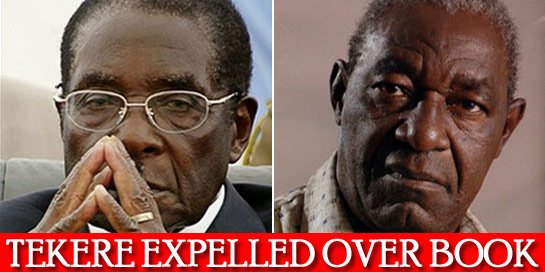
Serious Mugabe......very, very serious!
"In fact....the bottom line is to die in power for fear of the people's anger!"

gostats

Technorati

Technorati link

Add to Technorati Favorites

Credit goes to Newzimbabwe.com (and other websites!)
Credit goes to Newzimbabwe.com (and other websites!)
These postings are mainly from newzimbabwe.com and any other sites which will be acknowledged! Just feast as you go along!

About Me

My Photo
Rev Mufaro Stig Hove
I look for "The truth, the whole truth, and nothing but the truth" at all times.
View my complete profile

Previous Postings Archived Monthly!

Sunday, 8 July 2007

ROBERT MUGABE CHALLENGED BY PATRICK KOMBAYI!


RESPONSE TO ROBERT MUGABE’S UTTERANCES AT CHIKEREMA’S HERO’S STATUS

Robert Mugabe’s baseless utterance and outright lies in denying an obvious hero the deserved National Hero status cannot go unchallenged. Mugabe had the audacity to call James Dambadza Chikerema a “run- away” politician undeserving of the honours befitting a hero when one of his closest bedfellows, Nathan Shamuyarira of the Frolizi notoriety, is there for all to see as the best example of a ‘run-way’ politician.
Does he really think Zimbabweans are blind, ignorant and stupid?
What does he really take us all for?
I, Patrick Kombayi was there in the struggle and saw with my own two eyes the people who deserted the struggle for such selfish power hunger as the formulation of FROLIZI and, if Chikerema cannot be buried at the National Shrine then Zimbabweans have the right to know how many people who today lie at the shrine should, according to Mugabe’s criteria of heroes’ selection status and exhumed. If Mugabe’s criterion of heroes’ selection disqualifies those who ran away from the struggle then he will definitely be embarrassed when Nathan Shamuyarira eventually dies. Shamuyarira ran away from the struggle together with Chikerema and a group of Zezurus to join FROLIZI in 1971 at KAFUE and I, Patrick Kombayi was there as Chairman and returning officer of the Biennial Conferences of Zanu to elect the Dare, the party’s Supreme Body.
Zimbabweans wonder, and they have all the reason to, how James Chikerema could be less deserving of his country’s honours than even such white liberals like Guy Clutton – Brock. Does Mugabe think Clutton – Brock could be a more deserving Heroes Acre candidate than Dambadza? It really boggles the mind how Mugabe and his clique in the Politburo have allowed their common sense to be so impaired. Mugabe can surely stand in front of the whole world to spell out dreamt conditions, which he and his cowardly bootlickers have dictated as necessary for hero status forgetting that a long list of people who he has buried there would be disqualified. A quick glimpse at the graves at our national shrine will bring out such names as Solomon Tawengwa, Border Gezi, Chris Ushewokunze, Mombeshora, Enos Chikowore and many more, particularly Zezurus who lie there simply of their regional – ethic belonging. But as I have always said over the years, Mugabe is a man who keeps grudges to the death. His greatest enemy is he who dares to speak the truth about him exposing his true colours. Chikerema, his own father’s sister’s son, dared to stand up for the truth and he paid for those ‘sins’ up to the grave. That Chikerema did not fight for Zimbabwe to the end is just a flimsy excuse and worthless bragging of a vengeful and cruel dictator. Look at what Mugabe does to justify the disqualification of the likes of Noel Mukono, Joe Taderera, Sheba Gava (one of the first Commissioned female officers and liberation war cadres), Bossopo Moyo, Lookout Masuku and many other cadres who really started the struggle whose fruits he enjoys today. But, according to Mugabe and his cronies, they were not all heroes! My foot!
Like I have already said in Mugabe’s warped thinking, once you stand for the truth, you become his enemy and therefore a traitor who should be persecuted up to the grave. I say this from a personal experience. My liberation struggle history is public knowledge, well chronicled with documentary and pictorial evidence. Even Fay Chung, a totally unbiased participant and keen observer of the political goings- on in the liberation struggle, commits considerable space in her recent book about the struggle:
“RE- LIVING THE SECOND CHIMURENGA” to my contribution which some of Mugabe’s closest mates in the ZANU PF gravy train cannot even fathom. Chung was observant enough to notice how Mugabe loathed any possible threat to his ambition – real or perceived.
She says on pages 161- 162 of her ‘Memories from Zimbabwe’s Liberation Struggle’…Many others flocked to Geneva. As already noted, one such person was Patrick Kombayi, a brilliant businessman who had helped fill the leadership vacuum caused by the arrest of all full time Zanu and Zanla members in Zambia between 1975 and 1976. A brilliant strategist, as well as an amazingly courageous man, he harboured ambitions to become one party’s top leaders. For his indubitable achievement, he demanded to be recognized as a top leader within Zanu, but Robert Mugabe would not allow this…. Mugabe had once been Kombayi’s teacher in primary school in Gwelo and probably this relationship had influenced his judgement against Kombayi. Although Mugabe was in some ways a populist, adopting the policies that would carry the most favour at a particular time and place, he was very adamant with regard to who should be in the leadership of Zanu PF. While he brought Shamuyarira back into the leadership, he was totally against allowing Kombayi in…”
Fay Chung also remembers in her book how I, Patrick Kombayi went out of my way and risked my own life to procure weapons of war and other supplies for guerrillas in Zimbabwe and how I personally handled the provision of food for wives and children of the imprisoned guerrillas and those who were injured in the war.
Page 99 of Chung’s book reads in part,”…….. A number of committees were formed with John Mawema, the only full time freedom fighter in the group, assisted by a rich businessman named Patrick Kombayi, put in charge of ensuring that weapons and supplies continue to flow into Zimbabwe…. The last committee, headed by Kombayi, was in charge of providing food to the wives and children for the imprisoned guerrillas and the injured combatants, who were generally kept in Lusaka for medical treatment….” And she goes on to say on Page 110 “…. Patrick Kombayi, the head of the food committee appointed by an ad hoc committee was a brilliant businessman who owned a nightclub in Kafue, a small town near Lusaka. We worked very closely with Kombayi, who showed both exceptional courage and brilliance in devising ways and means to solve the food problem…”
These are a few observations by one person who finds them important to mention in her book and for the purposes of our national history but my contributions are simply innumerable. Mugabe is one person who knows very well how much sacrifice some of us put towards the liberation struggle but being the man he is, he has rewarded me with gunfire, which has crippled me. All because, like Chikerema, I am a man of principle, who stands for the truth, come rain come hail thunder.
I have said before that I fear nothing and nobody when it comes to telling the truth and setting the record straight. I want Zimbabweans to know that there has always been a cloud of suspicion with regard to the circumstances surrounding Mugabe’s so called ‘run-way’ with Edgar Tekere to Mozambique. That, as most of us who were in the of the political goings- on in the party at that time, was a pre- planned move orchestrated by Guy Clutton – Brock and some white liberals who had arranged Mugabe’s move into Mozambique ostensibly to go and join the struggle when in fact they wanted Mugabe to lead the party and agree to negotiations as Chitepo, who had been killed, had constantly refused any negotiations with the white settlers.
As such, the death of Chitepo raised a lot of suspicion that Mugabe and the Zezuru clique with the collusion of the white liberals had wanted to get rid of Chitepo to pave way for negotiations led by Mugabe. They were determined to avoid a situation where the Karangas who were leading the real armed struggle on the front, would stage a shoot-in take over the country. This is how, soon after Mugabe took party leadership, as per their plans, there were several conferences held while the Kangaras were in jails and detentions. There was the Geneva Conference in 1976 where Mugabe’s leadership was further endorsed to make their dream come true. There was also the Falls Bridge Conference (I attended that meeting together with Enos Nkala as the only Zanu representatives and I have minutes of that meeting) and other conferences back home by Joshua Nkomo and Muzorewa.
It is in this light that I and many others strongly believe that Mugabe and his group of liberal Rhodesians, FROLIZI and the Zezuru clique cannot be exonerated from the death of Herbert Chitepo. The white liberals, the Zezuru clique and Mugabe himself are strongly suspected to have had a hand in the death of Chitepo in order to have Mugabe leading the party and country. And Mugabe has shown his gratitude, hasn’t he?
Where is Guy Clutton –Brock buried today while veteran nationalists like Chikerema have been forgotten? How was Guy Clutton – Brock really involved in the liberation struggle to warrant him out National Hero status? As Mugabe himself said at Chikerema’s funeral: “Zvinyorwa zvake zvinonzi kudii?”
Finally, it is important to remember that it was the Zezuru groups that led Zapu and Zanu to form FROLIZI together with the white liberals and, their stumbling blocks were J.Z Moyo and Chitepo, who were assisted by Josiah Tongogara and Nikita Mangena. The death of these four stumbling blocks can then be not such mystery to some of us! They were simply thorns in some letter and documents pertaining to that story- some of them Mugabe himself – for example the formation of ZIPA, the so- called 9-by-9. I remember meeting Mugabe when we were burying JZ Moyo in Lusaka. That was the time I was filling in the leadership vacuum created following the arrest of our leaders.

By Dr Patrick Kombayi
Patron; The Zimbabwe Military
Academy

Thursday, 10 May 2007

"MUGABE PLANNING MORE VIOLENCE THIS YEAR!" TEKERE

Tekere warns of pre-election violence


HARARE - Firebrand nationalist, Edgar Tekere, has warned Zimbabweans of an escalating violence-ridden campaign in the period leading to next March's presidential and general elections.
The founding Zanu (PF) member said President Robert Mugabe would fight tooth and nail to retain power, and the current spate of abductions and torture of opposition officials would intensify in the run-up to the poll.
Tekere spoke as Mugabe called a special congress to endorse his candidacy as party leader and sole candidate for next year's presidential election. For the first time, the ruling party officially alluded to the Mujuru and Mnangagwa factions in Zanu (PF) and that they were embroiled in a bitter battle to succeed Mugabe.
Tekere said: "I think I know Mugabe fairly well. He doesn't like contests and when you stand against him he is going to fight tooth and nail."
The veteran politician was speaking in a telephone interview with The Zimbabwean from his Mutare home.
A former secretary-general of Zanu (PF), Tekere, who was once a close ally of Mugabe, was first expelled from the party in October 1988 for agitating against one-party state rule.
He formed the Zimbabwe Unity Movement and contested the 1990 presidential election, but lost to Mugabe. He resigned as ZUM president in January 2000.
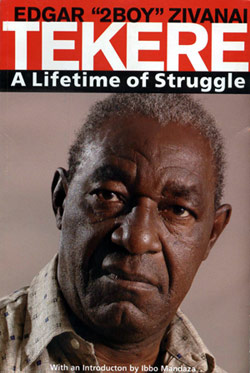
He was reinstated into Zanu (PF) in 2005 but was fired again last year after publishing a highly controversial autobiography, A Lifetime of Struggle, insinuating that Mugabe was a reluctant recruit into the liberation struggle.
Tekere said Mugabe, 83, had boasted of having degrees in violence and openly said opposition officials "vakadashurwa (were battered)" and that they will be "bashed" again if they provoke police.
He said: "There is going to be lots and lots of violence sponsored by the Head of State, make no mistake about it."
He said Zanu (PF) would unleash violence during the campaign period, which would then be toned down just before polling to hoodwink international observers.
Tekere said: "They will have broken your ribs and expect you to remember that on polling day."
He said because rigging elections had become difficult over the last decade, the ruling party would compensate for that through violence.
"You are dealing with a man who believes there is no Zimbabwe without him. One day he is going to die, but he doesn't think Zimbabwe will continue after him. All affairs of state start and finish with Mugabe," Tekere said.
He dismissed the possibility of a military coup in the event of Mugabe losing to the opposition.
He said: "One who is very outspoken on the issue is Didymus Mutasa, my uncle. Don't be deceived by him. The army will comply with the result. You only hear that from people like Mutasa. Have you ever heard it from the real masters of war, Rex Nhongo or Vitalis Zvinavashe?"
Rex Nhongo was the nom de guerre of General Solomon Mujuru - the powerful husband of Vice President Joice Mujuru - a retired commander of the Zimbabwe National Army, during the liberation war when he was Zanla's chief of operations. General Zvinavashe is the past immediate commander of the Zimbabwe Defence Forces, now Gutu Senator.
Mutasa, who is Zanu PF's secretary for admistration, is on record as saying Zanu (PF) would go to war if it lost the presidential election.
"There is going to be no such thing, I can tell you quite confidently," Tekere said.
He said youths were being trained under the guise of national service primarily to beat up the electorate.
Scores of people have been killed, mostly supporters of opposition parties, while more than 600 people have been tortured for sympathising with the opposition since March 11, according to opposition figures.


Yahoo! Mail is the world's favourite email. Don't settle for less, sign up for your free account today.

Wednesday, 9 May 2007

THE INTERVIEW BY THEARCHBISHOP PIUS NCUBE!

PLEASE CLICK BELOWAND SEE AND HEAR FOR YOURSELF!


The all-new Yahoo! Mail goes wherever you go - free your email address from your Internet provider.

Thursday, 3 May 2007

URGENT "STATE OF THE NATION ADDRESS" FROM THE OFFICE OF THE EXECUTIVE PRESIDENT!

"STATE OF THE NATION" ADDRESS BY YOUR PRESIDENT!


I think there is a bit of confusion in our beloved country of Zimbabwe today!

Who ever said I won the Presidential Elections of 2002?

I never said so!

All I said was Tsvangirai's Election Petitions are "frivolous and vexatious."

I also pleaded with all patriots to "recognize" me as the Executive President.

I am the only person who can keep this country of Zimbabwe together!

If I removed myself from the top seat, the country will degenerate into chaos (racialism, tribalism, regionalism and all the negatives you can think of!)

Now we are in this whole mess because you simply refused to do the obvious- JUST RECOGNIZE ME. PERIOD!

Do you honestly think Tsvangirai can run this country?

I'm very disappointed with you, my fellow countrymen!

Running a country is a very complicated, delicate task!

You do your best and you are still accused of not doing your best!

WHO REALLY COULD HAVE MANAGED THIS ECONOMY BETTER THAN ME?

Now about the so-called rigging and the so-called-violence!

Your focus should be on the major issues!

Would we really stand by and allow Mr Blair to re-colonize our country, take away our Sovereignty and take over all our resources?

Would you allow someone to take your wife and you just stood by?

Please lets be very serious, Ladies and Gentlemen, Comrades and Friends!

About assassinations:be very careful!

This may break the whole Nation apart!

Who killed Cde Hebert Chitepo?

So why do you ask who killed General Josiah Magama Tongogara?

About the so-called "Truth and Reconciliation Commission!"

Where and when do we start?

Who will remain without blood on his hands?

Do you know how Dr Parerenyatwa died? Was it Smith's men or was it an internal struggle?

So will you raise the dead to ask them to testify?

Then last but not least: where in the world are "perfect people"?

The words "rigging", "assassinations" etc are English words!

Are they Shona words?

MUTIKWANIRE! (STOP THIS LUNACY!)

Please recognize me, rally behind me as your God-given father and lets move forward and re-build our Nation!

About the unfortunate isolated incidents in the Southern part of our country (the so-called "Gukurahundi Massacres"), please lets not open old wounds!

The Ndebeles can be very naive if they think we have forgotten their vicious raids against our peace-loving Shona people in the 1890s!

Please let all bye-gones be bye-gones!

MAY THE GOOD LORD ABOVE BE WITH YOU ALL!

Yours Faithfully,

ME.


Yahoo! Answers - Got a question? Someone out there knows the answer. Try it now.

Wednesday, 2 May 2007

Mugabe pushes for reopening of Tekere murder case!

Mugabe pushes for reopening of Tekere murder case
By Our Correspondent
 
 
HARARE, May 1, 2007 - President Robert Mugabe is reportedly pushing for the reopening of the 1980 murder case of former government minister Edgar Tekere, who recently published an autobiography which is critical of him.
 
On August 4, 1980, a little over four months after Zimbabwe attained independence, Tekere, then Minister of Manpower Planning and Development, in the company of  bodyguards, visited a farm on the outskirts of Harare, where they shot and killed a white farm manager, Gerald Adams  .
  
Tekere went on trial, together with is bodyguards. But the High Court, on December 8, acquitted the veteran politician of the murder, bringing to an end a sensational case that threatened to undermine Mugabe's fledgling government.
 
Presiding judge Justice Pitman had found Tekere guilty of the murder of Adams and the attempted murder of five soldiers at Stamford Farm, but he was outvoted by the majority decision of two assessors Chris Greenland and Peter Nemapare, who agreed on the acquittal of the controversial politician.
 
The assessors held that while Tekere had killed Adams, he was acting in connection with the suppression of terrorism in terms of legislation inherited from rebel Rhodesian government of Prime Minister Ian Smith.
 
Tekere's autobiography, A lifetime of Struggle, which was published in January, was subjected to a barrage of criticism by ruling party politicians who claimed that the controversial politician was seeking to distort the history of Zimbabwe's liberation struggle in order to promote himself.
 
In his book, Tekere explained the role he personally played in Mugabe's ascendancy to power. His version of events riled Mugabe and his lieutenants, who dimissed Tekere as a mad man bent ondistorting history for personal gain.
  
Following this controversy, sources in the ruling party now say there are steps being taken to re-open Tekere's old murder case. Mugabe is reported to have ordered the Attorney General's Office to revisit the case and find if they are any loopholes to bring the firebrand politician back on trial.
 
"As we speak right now some senior police officers have been instructed to re-open the case," said the source. "They have been asked to do a thorough job on the matter.
 
"It's an uphill task, but they have no choice. You know if that man gives you orders...you have to act accordingly he is the most feared man in this country."
 
Legal experts, however, dismissed the attempt to bring Tekere back to trial as a futile exercise by a desparate Mugabe, who had failed to run the country and now sought to vent his rage on every one opposed to his views.
 
"There is no legal basis to re-open the case," a legal expert in government said. "You can never be re-tried once acquitted by a competent court on substantial the same charge, even if there was new evidence to show clearly that he committed the crime.
  
"It's the president's strategy to discredit his rival." 
 
Tekere, a former secretary general of the ruling party was expelled from the ruling party for the second time, last month, after the Manicaland Zanu-PF provincial executive found him guilty  of "denigrating and vilifying" Mugabe in his autobiography.


Yahoo! Answers - Got a question? Someone out there knows the answer. Try it now.

Thursday, 26 April 2007

"DOES MUGABE WANT ALL OF US TO BE HIS WIVES?"

http://www.thezimbabwean.co.uk/viewinfo.cfm?linkcategoryid=3&linkid=8&id=4174

Patrick Kombayi, one of the leaders of the movement that fought the liberation war and later became the first black mayor of Gweru believes his former teacher President Robert Mugabe was corrupted by absolute power. He also blames the people of Zimbabwe collectively for the current problems bedevilling the country. He speaks to our special correspondent.
SC-On March 24, 1990 you survived an assassination attempt by two CIO officers, Alias Kanengoni and Kizito Chivamba, who were sentenced to seven years in imprisonment but then pardoned by Mugabe through the use of Presidential powers of clemency. What is your view of the powers Mugabe wields under the current constitution?
PK- Mugabe and I never saw eye to eye again from the moment I said we had to give it to a people's congress to elect the leader of ZANU whilst he wanted to grab the position. Then came the elections of 1990 where I stood against his handpicked Vice President, Simon Muzenda and before which I was almost killed by the CIO people. I wasn't surprised by the pardon knowing Mugabe as I do. He wanted me eliminated. He allowed the election to be held in the constituency despite me fighting for my life in a Bulawayo hospital. If it was in progressive democratic countries, the election could have been postponed. Despite that, I won. The people who were counting the votes called me straight from the command centre to congratulate me. However, Tobaiwa Mudede when announcing his own version of results gave my 14 000 votes to Muzenda and gave me his 8000 votes, 2000 of which he claimed had come from postal votes by army members fighting in Mozambique. He failed to justify such a shocking claim when I challenged it.
SC-What role do you think your ZUM party played in moulding Zimbabwe's current so-called multi-party democracy?
PK-We definitely managed to stop the system of one-party-state. We didn't form ZUM because we wanted to rule at the time. We knew Mugabe was still popular and had not yet made many mistakes as is the case now. Even when we formed the Forum party, the main purpose was to stop the one-party-state system.
Having experienced Kaunda and Nyerere failing with the one-party-state system we decided with some international cooperation from some Front Line leaders to form ZUM and FORUM.
SC-You were the first black Mayor in post-independent Zimbabwe. What is your view of local governance in Zimbabwe at the moment?
PK-It is no longer local governance. It is now Mugabe's type of rule where the people that were democratically elected into the local councils kicked out to be replaced by appointed commissions.
But consider this: Sekesai Makwavarara leading the Harare Commission after the ouster of Elias Mudzuri quit the liberation movement together with Nathan Shamuyarira to form FROLIZI. Ignatius Chombo, who is orchestrating all this chaos, was also a member of FROLIZI. He is picking his former FROLIZI colleagues to fill the commissions.
SC-You worked closely with Mugabe during the liberation struggle in Zambia. Do you think he still remembers the reasons you went to war for?
PK-Yes, he still remembers. The only problem is that he is a politician with hunger for power. He got absolute power, which corrupt absolutely. But I don't blame him alone because we the people of Zimbabwe have contributed to this mess.
Let me cite some few examples. He sent soldiers to Mozambique without approval from parliament. We don't even know how much was spent there, even the number of casualties. We remained quiet.
He did the same with the war in the DRC, where my brother Col Kufa died and the story was the same. Zimbabweans didn't do or say anything.
When we got independence we received a lot of money such as that from ZIMCORD. We don't even know how much it was, only Mugabe and Chidzero did and the account is still private to Mugabe. We never questioned.
Even the money which came from Britain for de-mobilisation of our army members was never accounted for. There was looting of state funds by ZANU PF as a party as well as money from NSSA and ZIMDEF without us questioning and that is why I blame the people of Zimbabwe.
SC-You are now MDC secretary for Gweru. Do you think the MDC has the intellectual clarity and gravitas to form the next government?
PK-If intellectual abilities are what determined the capacity to provide good leadership, then the MDC has the right material because there are many intellectuals in the party. But in my view, it is not merely academic power that matters in leadership but the need for good policies, which the MDC has as well. The leadership of the MDC is very capable of implementing these policies. I am confident because we work as a team in the party, guided by a clear constitution.
SC-Founding Zanu (PF) secretary general Edgar Tekere has just published an autobiography claiming Mugabe was a reluctant recruit into the liberation struggle. How accurate is Tekere's narration of events?
PK-Very accurate. Remember it was Tekere, Eddison Zvobgo, Enos Nkala, Morris Nyagumbo, Rex Nhongo, Herbert Ushewokunze and sometimes myself who could manage to stand up to Mugabe and tell him the truth after he had made himself very powerful in Zanu. Hence all of us became his enemies. I remember Nkala saying 'khati hau madoda uMugabe ufuna ukusiyenza abafasi bakhe yini? (Mugabe wants all of us to be his wives).'


Yahoo! Mail is the world's favourite email. Don't settle for less, sign up for your free account today.

Friday, 20 April 2007

ABIGAIL MPISA'S PERSPECTIVE OF MUGABE, TEKERE !

Mawere and 'the hand that profitably fed him'


Masawi threatened over Tekere book

Tekere unfazed by Zanu PF expulsion threats

Hysterical reaction to Tekere belies fear

Book shop won't sell Tekere book

Tekere absolves Mugabe of Tongogara's killing

'We produced a creature that destroyed this country' - Nkala

Tekere says Mugabe 'insecure' in new book
By Abigail Mphisa

Last updated: 01/24/2007 03:22:41


HAVING
read Edgar Tekere's book, I did not get the impression that we were being told that Robert Mugabe did not have a mind of his on, which got me asking; did your columnist Mutumwa Mawere actually read it?
It is dangerous to join a debate based on a book that one has not read. He has concluded that Tekere sought to re-write history. In order for anyone at all to make such a categorical statement against liberation stalwarts like Tekere, it then becomes necessary to provide readers with sources of accurate records of the liberation struggle.
What exactly are the "misunderstood democratic values" that the country appears to be in search of? If, in accordance with Mawere's views, Mugabe does possess democratic values, why is there overwhelming evidence to the contrary? I personally would need specific examples.
A democratic leader would not have abolished the post of Prime Minister and become an executive president without seeking the mandate of the Zimbabwean people. He would not have unilaterally sent Zimbabwean soldiers to their deaths in the jungles of the Congo and pulled Zimbabwe out of the Commonwealth because he was being asked to adhere to the Harare Declaration. The ascendancy of Joice Mujuru to the deputy presidency was undemocratic. People were dismissed from the party for seeking to exercise their democratic right to lobby for a candidate of their choice. The list of undemocratic actions carried out by Mugabe is endless and Mawere knows it.
I hold no brief for Jonathan Moyo. In my view, he played a pivotal role in the economic and political demise of Zimbabwe. Anyone who conjures up laws such as AIPPA, calls it an excellent piece of legislation and goes on to actively support POSA is downright evil. He was an active participant of the land reform project, claiming it would create 800 000 jobs and some say he was a multiple farm owner. He was determined to see the destruction of Kondozi Estates and the fact that many former workers were abandoned along the highway to Mutare did not move him. In fact, I do believe a Jonathan Moyo with power would be an extremely dangerous person. He proved it beyond any reasonable doubt during his five year reign of terror while in government.
But, to claim that in his piece "Hysterical reaction to Tekere belies fear", Moyo sought to defend Tekere sounds illogical. Defend him from what and whom exactly?
ZANU was never really a democratic force. One only needs to compare it with the ANC of South Africa, or even ZAPU. If ZANU had been democratic, amendments to the Lancaster House constitution would have been those meant to strengthen democratic institutions instead of creating a dictatorship, as has been the case in the majority of the 17 amendments. Who exactly are those people who want their versions of history to be the only ones in relation to how leaders in Africa ought to be selected?
Here is one statement that I had to read several times because I genuinely thought that a person of Mawere's intellect cannot possibly believe in it; "We do not have any record of Mugabe being comfortable as a beneficiary of an opaque selection process or seeking to avoid elections." Where has this gentleman been? Zimbabwe might not have missed a single election but, apart from the reprehensible and downright barbaric manner in which our elections are conducted, the electoral laws themselves are meant to ensure that Mugabe remains in power. Only a democratic coward could have enacted such laws. Whether Mawere likes it or not, Mugabe and his lieutenants are indeed afraid of the vote. Very much so! Here are a few examples;
Excessive use of force by Zanu PF More than 150 people died in the run up to the 2000 and 2002 parliamentary and presidential elections respectively. In one example Tichaona Chiminya and Talent Mabika of MDC were petrol bombed in their campaign vehicle in broad day light and they died in the inferno. The alleged murderer was one Joseph Mwale, a CIO operative who has never been brought to trial. Not a single statement was issued by Mugabe condemning the violence. He had in fact, at a rally in Manicaland, proclaimed that "death will befall you", a message intended for all those who were bent on opposing his party.
Downright rigging happens in our elections. Margaret Dongo proved it in the case of Sunningndale. Bernard Chidzero congratulated Henry Hamadziripi for having won Harare Central in the 1990 elections but was surprised later to be told he had won because some postal votes from somewhere were added to his lot. More recently in 2000 Zanu PF victory was nullified in the case of more than twenty constituencies. Needless to say the Zanu PF parliamentarians in question did not vacate their seats because they appealed and not surprisingly, the appeals were never heard.
It has also been proved that Zanu PF uses food as a weapon against peasants who may wish to support the opposition.
Opposition parties cannot campaign freely. Under POSA, they hardly ever get permission to assemble. In the event of permission being granted, their rallies are often violently disrupted by the Mugabe sponsored youth militia.
The voters' roll has always been a bone of contention because it has always been a shambles. The Registrar General consistently refuses to provide electronic copies and the costs of securing hard copies are prohibitive. It has been proven that dead people do in fact participate in our elections.
Mawere has to be aware of the implications of the Citizenship Act which was passed into law just before the 2002 presidential elections with the enthusiastic support of Jonathan Moyo, one might add. Millions of Zimbabweans by birth were deprived of their right to vote because this new piece of legislation claims that because their parents were born elsewhere, they are deemed to belong to their parents' countries of birth. Twisted logic indeed. Jonathan Moyo now views it as a "primitive" law, even though he supported its enactment.
In the 2005 parliamentary elections, observers were only invited from countries whose favourable views were a foregone conclusion. Mugabe personally vetoed the invitation list. It was as if he was inviting people to something as private as a wedding.
I did not get to vote in the presidential elections of 2002 despite investing 21 hours of my time in a queue. For some inexplicable reason we were simply tear gassed from the polling station. Voting stations in urban areas had been drastically reduced so there were only 60% of the 2000 numbers.
Mugabe single handedly appoints the Electoral Supervisory Commissioners.
One could go on and on. There is overwhelming evidence that we did not elect Robert Mugabe to be our leader in 2002. For that Mawere should turn to the numerous reports by international observers. One of them, in fact that of the Commonwealth observer group, partly explains why we are no longer a member of that body. Mugabe was incensed that a fellow African, a Nigerian, authored a report that questioned his democratic credentials. The fact that we allowed Mugabe to stay in power even though we did not vote for him is a different story altogether and has been and continues to be debated at different fora. And by the way, if Mugabe was not afraid of elections he would not be seeking to extend his term by another two years to 2010 in the name of harmonizing parliamentary and presidential elections. Why not harmonize in 2008?
Mawere argues that Mugabe's behaviour is consistent with that of a democrat. If Mugabe believed that the move to remove Ndabaningi Sithole from power was undemocratic, why did he not speak out against it? How come Sithole's remains are not interred at the national shrine when in fact Mugabe is the only one who decides who gets buried there? Without listing them, Mawere also alludes to values that inform Mugabe's choices. For examples, what values informed his choices when he gave land to people who are unable to utilise it so that Zimbabwe is now a basket case when less than a decade ago we used to export food? What values informed his decision to award $3 billion dollars to ex-combatants against the advice of his Minister of finance, thereby triggering an unprecedented economic downfall?
It is patently dishonest to say when Tekere set up his own political party Mugabe allowed him to compete freely for the national space. Patrick Kombayi, the then ZUM candidate for Gweru urban nearly lost his life at the hands of Mugabe's henchmen. His crime was to dare exercise his democratic right against Simon Muzenda. Elias Kanengoni and Kizito Chivamba (head of CIO for Midlands and ZANU P.F. youth league member respectively) were found guilty of attempted murder. Instead of condemning such acts of senseless violence, Mugabe pardoned the culprits. What sort of message does that send and what does it say about Mugabe's democratic credentials when an individual whose salary is paid for by the tax payer commits a heinous crime and is immediately shielded from jail?
Contrary to Mawere's assertion under the heading "Disclosure Two", Moyo did not express the view that Mugabe should have been eternally grateful to people who propelled him to the throne. He simply pointed out that Mugabe marginalised anyone whom he viewed as a potential contender to the throne. This point of view, one might argue, is actually borne by facts. For example, how would Mugabe explain the selective sacking of Maurice Nyagumbo, Dzingai Mutumbuka and Enos Nkala in the aftermath of the Willowgate scandal? In the case of Nyagumbo, Mugabe's heartlessness could not have been better demonstrated. Nyagumbo offered to resign as soon as his name appeared in the press. Mugabe begged him to stay, arguing that he would feel abandoned since he viewed Nyagumbo as one of his closest confidants.
However, when public and international opinion expressed disgust over the issue, Mugabe felt the need to fire a few people and Nyagumbo was identified as one such scapegoat. The three were not the only ones who had misused the Willowvale motor vehicle facility. There were a host of others, among them Mugabe's late wife Sally Mugabe. By asserting that a president of a country should put national interests above those of the party, it is as if Mawere actually believes that Mugabe adheres to this principle. Since when has Mugabe ever put Zimbabwe's interests above those of Zanu PF? It is an open secret that Zanu PF dips into state coffers with impunity and civil servants are often coerced to fund party activities.
Mawere, for whatever reason, might decide to see no evil and hear no evil, but Mugabe does come out as an evil and vengeful leader. Twenty thousand people perished in Matabeleland between 1980 and 1987. Those who oversaw the bloodbath were rewarded with promotion. In June 2005 seven hundred thousand people (18% of Zimbabwe's population) were rendered homeless through the infamous operation Murambatsvina. In excess of 2 million people were indirectly affected by that operation. Only an evil leader can do that to his own people! His treatment of Joshua Nkomo, one of the luminaries of Zimbabwe's liberation struggle, was downright evil.
Under "Disclosure Three" Mawere questions Moyo's support for the view that Mugabe is 90% responsible for the mess that our country is in. The point is, we may quibble over percentages but being leader means being responsible for the direction that one's country takes, warts and all. Mugabe literally sowed seeds of corruption and nursed them to fruition. Now our country boasts being in the top 30 most corrupt countries in the world.
Gideon Gono drives a US$138 000 vehicle because those are the values that Mugabe inculcated into the national psyche. Mugabe is driven in a custom made bullet proof vehicle which at the time of purchase was said to be the fourth such vehicle on the continent. The vehicle was purchased at a time when the fuel situation had started to bite and 4 million Zimbabweans needed food. He is escorted by a fleet of no less than ten vehicles. He has two state houses opposite each other in Harare, apart from the fact that he now has a private home in Borrowdale where he is making life miserable for his neighbours. Let us not forget that Ian Smith drove around in a Peugeot 504!! So, what percentage in terms of blameworthiness would Mawere rather attribute to Mugabe?
I am not too sure what Mawere's problem is regarding Moyo's New Year resolution. Why on earth does he believe that 2007 is a year of action for Zanu PF only? How does Moyo's designation of 2007 as a year of action translate into an assertion that Zimbabweans should expect it to be a better year? Mawere argues that Moyo got it wrong on Tsholotsho hence he cannot possibly get it right on 2007. What kind of logic is this? Isn't life about sometimes getting things wrong and at other times getting them right? Besides, what exactly did Moyo get wrong about Tsholotsho? The long and short of it was that a group of people got together to put together a strategy to have their preferred candidate elected and were punished for it. If anything, Tsholotsho confirmed Mugabe's high handedness and lack of respect for the constitution of his own party.
In the end, the debate shifted from issues raised in Tekere's book to an attack on Moyo's hypocrisy. The bottom line is, Mawere is of the opinion that Moyo should not criticise the hand that profitably fed him. How tragic. For me the big question that Mawere should have asked, instead of accusing Tekere of re-writing history (sadly, without providing evidence that this is indeed the case) is, why has Mugabe remained mum? Why are people falling all over themselves to defend a man who is very much alive and has all the resources to make himself heard?
Mawere does seem to have joined the list of Mugabe's praise singers. Could there be truth in that he was a beneficiary of the Zanu PF patronage machinery hence his reluctance to criticise – to use his own words – "the hand that profitably fed him", with the hope that his properties may be returned to him?
By the way, I did read the numerous articles in which Mawere sought to rubbish the view that he benefited from being well connected to those at the top of the Zanu PF hierarchy. I am saying this so that he does not feel the need to tell his side of the story once more. At the end of the day, after having advocated that people should avoid getting personal when debating issues of national importance, Mawere failed dismally to adhere to that principle. The starting point should at least have been to read the book.
Abigail Mphisa writes from Bulawayo. She can be contacted on


Yahoo! Mail is the world's favourite email. Don't settle for less, sign up for your free account today.

MASAWI SURVIVES TEKERE TURMOIL!

Masawi survives Tekere turmoil
 

Staff Reporter
 
http://www.fingaz.co.zw/story.aspx?stid=2899

ZANU PF deputy information secretary, Ephraim Masawi, appears to have escaped unscathed by the farce that gripped his party over Edgar Tekere's controversial memoirs for which the maverick nationalist was sacked from the party.

ZANU PF's influential youth league had recommended that Masawi, the Mashonaland Central governor, be suspended for attending the launch of a book by former nationalist Tekere, which dims President Robert Mugabe's liberation war credentials.
John Nkomo, ZANU PF chairman and head of the party's national disciplinary committee, had indicated that the matter was in the hands of Masawi's Mashonaland Central province.
However, Chen Chimutengwende, leader of the party's Mashonaland Central provincial structure, said his province was not handling the matter.
"Chimutengwende said Masawi would be treated differently from Tekere since the latter had been an ordinary member, whereas Masawi held a position of authority in ZANU PF.
The Masawi saga had opened up rifts in the party, with one faction latching on to the controversy to push for ZANU PF Guruve Member of Parliament Edward Chindori-Chininga to replace the ruling party deputy information secretary.
Chindori-Chininga, a former minister of mines and mining development, was dropped from President Mugabe's Cabinet in 2004.
But, according to Chimutengwende: "There are no vacancies yet."
The ZANU PF youth league had felt that Masawi "failed to defend the party's first secretary", leaving the task to people such as opposition activist Patrick Kombayi.


Yahoo! Answers - Got a question? Someone out there knows the answer. Try it now.

Monday, 9 April 2007

TEKERE THREATENS TO SUE THE STATE MEDIA!

Tekere remains unfazed, threatens to sue state media

http://www.zimbabwejournalists.com/story.php?art_id=1636&cat=4


By Ian Nhuka

MUTARE - Maverick war veteran, Edgar Tekere, embroiled in a storm over his book that fires broadsides at President Robert Mugabe's leadership style, does not care about the criticism he is receiving from Zanu PF or threats to expel him from the party he helped found in the 1960s.
Tekere, a nationalist and respected Mutare-based war veteran, told
zimbabwejournalists.com in an interview here Tuesday that while he accepted reasonable criticism, he did not like "malicious statements" carried by sections of the State-controlled media since he triggered the on-going national debate when he launched his book some two weeks ago.
He threatened to sue some government-controlled media outlets for defamation over some stories they have carried since he unveiled his controversial book.
He did not specify the offending statements or the media outlets that
he thinks defamed him. Tekere charged at his critics saying they were rushing to criticise him, but some of them have not read his autobiography, "A Lifetime of Struggle," which was edited by Dr Ibbo Mandaza, an academic of note.
He said: "They are falling over each other to please Mugabe by attacking me.  Some of them have not even read the book.  You can see that from their arguments, which I think are not informed at all."
In the book, Tekere says President Mugabe is a weak person, adding he is responsible for the economic crisis gripping the country.  He regrets playing an leading role in elevating President Mugabe to head Zanu during the liberation war.
Over the weekend, the Zanu –PF Youth League, asked the ruling party leadership to expel Tekere from the party, a little over a year after he was re-admitted into the fold.
His readmission came after many years spent in the political wilderness following his decision to wind up the Zimbabwe Unity Movement (ZUM), a party he founded to challenge Mugabe in the 1990.
The youth league also proposed punishment to be meted on some leading party officials who attended the launch of Tekere's book, among them Mashonaland Central governor and Zanu – PF deputy politburo secretary for information and publicity, Ephriam Masawi.
The party leadership is now considering the request for Tekere's
expulsion, according to reports in the public media yesterday, which quoted senior officials.
"I do not care if they expel me," said Tekere. "If they do, that will further show that there is no democracy and freedom of speech in Zanu PF.  The book contains my personal opinions about the
war.  So why will I be punished for my opinions?"
Last week, a State-controlled weekend newspaper said in its lead story Tekere was not a serious person since "he suffered bouts of mental instability in the past."
The newspaper quoted George Rutanhire, a war veteran and former deputy minister who said:
"Tekere munhu akamborwara (Tekere once suffered mental instability)."
Another publicly-owned newspaper followed up the story, scorching
Tekere's claims that he was personally instrumental in the rise of President Mugabe during the liberation war.
It said freedom fighters, through the Mgagao Declaration of 1976,
collectively made the decision to elevate President Mugabe to the post of interim Zanu leader, replacing the late party president, Ndabaningi Sithole who had been sacked for alleged prevarication.
Tekere has often ruffled the feather of senior party members.  At some stage in the late 1980s, he clashed with President Mugabe over his dictatorial leadership style and his failure to curb corruption.
That precipitated his expulsion in 1988, after which he formed ZUM.  His party contested in the 1990 elections and won a number of parliamentary seats and did well in the presidential race.
However, the party soon fizzled out after the violence-ridden poll but
the veteran politician still commands respect from the Zanu – PF ranks.
Now, he spends most of his time in Mutare or at his horticulture farm,
near Old Mutare.
In the interview with Zimbabwejournalists.com, Tekere also lashed out at police commissioner, Augustine Chihuri and presidential spokesman, George Charamba, for attacking him in the media.
Charamba, is widely believed to be the writer of a weekly column, The Other Side, published on Saturdays in The Herald under a pseudonym.
The column recently savaged Tekere soon after he launched his book, claiming that he did not have the moral ground to criticise Mugabe who, according to Charamba, salvaged him (Tekere) from financial ruin a few years ago.
In his newspaper interview with The Herald, Chihuri said Tekere has a history of violence, mental instability and is an alcoholic.
But Tekere remains unfazed.
"These people are attacking me but they do not know that they are
committing a serious offence of defamation.  I am considering suing them for defamation and the publishers involved.  Some of their criticism is malicious," he blasted.
Tekere was readmitted into Zanu PF late 2005 but was barred from
seeking election to any post in the party for five years.
It is because of that condition that he was barred from contesting in
the senate polls that were held in November 2005.
"I am not bitter about the party's decision to bar me from holding any post although I think it doesn not make sense.  However, I will remain a card-carrying party member. --- I have heard some people saying that I am criticising Mugabe in my book and at other forums because of that decision.  That is not true.  --- I started writing this book seven years ago, so it is false that the criticism of Mugabe is an attempt to get revenge on my part," he said.


New Yahoo! Mail is the ultimate force in competitive emailing. Find out more at the Yahoo! Mail Championships. Plus: play games and win prizes.

Tuesday, 3 April 2007

INTERESTING FACTS ABOUT CDE EDGAR TEKERE!


  Tekere, Edgar
 
CANDIDATE DETAILS
 
Affiliation ZANU - Patriotic Front   
Name Edgar Tekere
Address
, , Zimbabwe
Email None
Website None
Born 00, 1937
Died Still Living (70 years)
Contributor Pimpalicious
Last Modifed Thomas Walker
Feb 21, 2007 03:58pm
Tags
Info Edgar Zivanai Tekere (born 1937) is a Zimbabwean politician. He was a leader of the Zimbabwe African National Union who organised the party during the Lancaster House talks and served briefly in government before his popularity as a potential rival to Robert Mugabe caused their estrangement. He fought against Mugabe in the 1990 election and was heavily defeated, but remained involved in politics and has recently rejoined ZANU (PF).

Tekere was an early ally of Robert Mugabe within the Zimbabwe African National Union (of which he was a founder member in 1964) during the fight for independence and against the Rhodesian Front government of Ian Smith. Mugabe and Tekere went together into Mozambique in 1975 to launch the war against Rhodesia, and Tekere was appointed as Secretary-General of ZANU.

When ZANU won the 1980 elections, Tekere was appointed Manpower Planning Minister from 1980 in Mugabe's Cabinet. He followed his appointment by making a series of outspoken speeches which went far beyond government policy. Shortly after his appointment, on August 4, 1980, he greeted Mugabe (then Prime Minister) and visiting President of Mozambique, Samora Machel in combat fatigues and announced that he was going "to fight a battle". Tekere and his bodyguards went looking for supporters of Joshua Nkomo's ZAPU outside Harare, but failing to find them, went onto a neighbouring farm and shot a white farm manager called Gerald Adams.

Tekere retained his government post when he went on trial together with seven bodyguards who were all former guerilla fighters in the independence war. On December 8 the High Court, on a majority decision, found him not guilty of murder. Two out of the three assessors held that while Tekere had killed Adams, he was acting in connection with the suppression of terrorism.

Tekere was dismissed from the government on January 11, 1981, a decision he was reported to be happy with; he retained the Secretary-Generalship of ZANU. In April 1981 he was detained by Kenyan security forces to prevent him from speaking to students after giving a newspaper interview in which he said he was proud of the killing of Gerald Adams. In July, Tekere referred to some ZANU representatives as having "inherited the colonial mentality", which was straining relations between them and the party's supporters. Mugabe hit back by saying "Those who are complaining that the revolution is not continuing .. are the most immoral and laziest in the party". Tekere was increasingly seen as a leader of a rival faction to Mugabe, and was dismissed as Secretary-General on August 9 with Mugabe taking the post himself.

When Mugabe launched 'Operation Gukurahundi' against Joshua Nkomo's supporters in Matabeleland in 1982, Tekere voiced his support for the action as necessary to prevent "a Biafra situation". After criticising corruption in the party, in August 1984 Tekere was elected to the Central Committee of ZANU (PF) and carried shoulder-high from the Congress; he was also being supported by the Whites in Zimbabwe after opposing the farm squattings by ZANU (PF) supporters which he described as "donga watonga" (chaotic government). He was provincial chairman of ZANU (PF) in Mutare.

Tekere supported Mugabe at the 1985 elections but by October 1988 his consistent criticism of corruption resulted in his expulsion from the party. When Mugabe voiced his belief that Zimbabwe would be better governed as a one party state, Tekere strongly disagreed, saying "A one-party state was never one of the founding principles of ZANU(PF) and experience in Africa has shown that it brought the evils of nepotism, corruption and inefficiency".

He ran against Robert Mugabe in the 1990 Presidential race as the candidate of the Zimbabwe Unity Movement, offering a broadly free market platform against Mugabe's communist-style economic planning. Mugabe won the election on April 1, 1990 receiving 2,026,976 votes while Tekere only got 413,840 (16% of the vote). At the simultaneous Parliamentary elections the ZUM won 20% of the vote but only two seats in the House of Assembly. Zimbabwe Unity Movement supporters were the targets of violent attacks from supporters of ZANU (PF), and five candidates were murdered, a student represantative Israel Mutanhaurwa of ZUM was abducted in broad daylight by suspected state agents at the local cinemas in Gweru to be dumped later in the outskirts of Mkoba a local surbub unharmed, noone was arrested or convicted of the crime. Those convicted of the attempted murder of former Gweru Mayor Patrick Kombayi who was shot in lower abdomen but survived the shooting, were pardoned immediately afterwards.

Tekere dropped out of sight after the election, fuelling rumours that he was planted as an opposition figure. In 2005 he voiced his wish to stand as a ZANU (PF) candidate for the Senate of Zimbabwe but was rebuffed. In 2006 it was reported that he had rejoined ZANU (PF). A letter sent to him by ZANU (PF) national chairman John Nkomo dated April 7, 2006 said "You will not exercise your right to be elected to any office in the party for a period of five years. You will be required to uphold all the duties of a member listed in Article 3, Section 18 of the amended Zanu PF constitution".

[Link]

JOB APPROVAL POLLS

BOOKS
Title Purchase Contributor

EVENTS
Start Date End Date Type Title Contributor

NEWS
Date Category Headline Article Contributor

DISCUSSION
[View Previous Messages In This Discussion (1 Previous)]


Inbox full of unwanted email? Get leading protection and 1GB storage with All New Yahoo! Mail.

TEKERE: "ZANU-PF's SUPPORT FOR MUGABE A DISASTER!"

Zimbabwe's Ruling Party Backs President Robert Mugabe In 2008 Run

April 2, 2007 1:27 p.m. EST

Ihuoma Ezeh - All Headline News
 
Harare, Zimbabwe (AHN) -
 
The Zanu-PF party, Zimbabwe's ruling political party, is supporting President Robert Mugabe in his run in the 2008 election.
The news came as two opposing party factions were eager for Mugabe to stand down in order to end the political and economic crisis in Zimbabwe.
Nathan Shamuyarira, the party's spokesman, announced in a meeting in Harare that the party was endorsing Mugabe as its candidate for the 2008 election.
"The resolution was accepted by the central committee," Shamuyarira said. "The candidate for the party in 2008 will be the president himself."
Edgar Tekere, a Zimbawean veteran, said endorsing Mugabe would be a disaster.
"They are engaging in their madness of singing 'Mugabe, Mugabe!' That's no good for the country and for the party," allafrica.com quotes Tekere as saying. "It means we are going to continue to sink."
Peter Biles, BBC's southern Africa correspondent, said Mugabe's critics are convinced that his leadership is strongly damaging the country, and that with the economy out of control, Mugabe should step down.
The Movement for Democratic Change, an activist group in Zimbabwe, said the news was shocking.
Mugabe, 83, has been president since 1980, when Zimbabwe obtained its independence from Britain.


New Yahoo! Mail is the ultimate force in competitive emailing. Find out more at the Yahoo! Mail Championships. Plus: play games and win prizes.

Saturday, 31 March 2007

Dear Dr John Makumbe,

We heard you "LIVE" on Radio "702" here in South africa giving an Ultimatum to the South Africans about their expected role in the resolution of the Mugabe-made crisis in Zimbabwe!
 
We agree with you in full and we are asking you issue that particular ultimatum in writing so we can post it on our blogsites!
 
We hold you in the highest esteem and we thank you for your kindest co-operation in this regard!
 
Rev Mufaro Stig Hove.
 
THE RADICAL SOLDIER.


Cell: 0791463039 RSA.


The all-new Yahoo! Mail goes wherever you go - free your email address from your Internet provider.

Friday, 30 March 2007

MESSAGE FROM THE ZCTU AND ZINASU!

We are starving; we will eat your teargas!!!
 
.
 - Zimbabwe National Students Union
 
The Zimbabwe Congress of Trade Unions (ZCTU)
 
has resolved that:
  • All workers be mobilised to stay away from work from 3 to 4 April 2007
  • National actions will be called for after every three months and they will be incremental until the situation improves
Poverty. Hyperinflation. Oppression. Unemployment. Failure of basic services.
  • Show your disagreement with how our country is being mismanaged and SUPPORT the ZCTU and STAY AWAY ON 3 and 4 April 2007
  • Read the ZCTU communique about the stay away on http://www.zctu.co.zw/html/stmts/21906.shtm or contact them for more information, on email info@zctu.co.zw or phone +263-4-794702/42 or +263-4-702517.
  • Lobby your friends and colleagues - forward this email on to them.
Let the workers organise. Let the toilers assemble. Let their crystallized voice proclaim their injustices and demand their privileges. Let all thoughtful citizens sustain them, for the future of Labour is the future of Zimbabwe.


All New Yahoo! Mail – Tired of unwanted email come-ons? Let our SpamGuard protect you.

Friday, 23 March 2007

CDE EDGAR TEKERE RECOUNTS THE VISIT OF THE GREAT ROBERT NESTER MARLEY!


Stanley Kwenda
Harare
FORMER ZANU PF secretary general, Edgar Tekere, recounted recently how he invited the late legendary reggae icon Bob Marley to Zimbabwe's Independence celebrations in 1980.
"Bob Marley was my guest. I was responsible for looking after him, I invited him for the celebrations," said Tekere to a raucous response from journalists who packed the Ambassador Hotel's Quill Club. "I sent out two people to Jamaica, Job Kadengu and Godern Muchanyuka. Each one of us who was in government at that time had an opportunity to invite two guests paid for by the state," he said.
Africa 2007
Tekere, who spoke passionately about Marley, said a Serbian friend, Olivier Jovanovich who is now at the Serbian embassy in Pretoria helped him hook up with Marley. "The whole affair was organised by Richard Hove who was taking care of the finances. I liked music and sometimes I could take time off and go to Londoner to enjoy music," said Tekere.
Tekere also said that he had a very good relationship with the then Prime Minister of Jamaica, Michael Mann who helped facilitate Bob Marley's trip to Zimbabwe.
"Mann told me a lot about Bob Marley's expenditure on the poor. He told me that at any given time there were hundreds of poor people feasting at his house. The guy was a friend to Marley," said Tekere.


All New Yahoo! Mail – Tired of unwanted email come-ons? Let our SpamGuard protect you.

Tuesday, 20 March 2007

SPECIAL COMMENT POSTED ON WEBSITE!

Zimbabwe is about White Supremacy

BY John Iteshi

http://johntina1.spaces.live.com/


Izhiogoagbo@yahoo.com


London


Racism, the worst kind of racism is the only reason for British media's
obsessions about Mugabe. Nothing in Zimbabwe equates to one tenth of what
happens in each of the 36 states of Nigeria. What the opposition leader
Morgan Tsvangirai, did by trying to instigate mass uprising, cannot be
attempted successfully by anybody in Nigeria today. Just dreaming of it
aloud will put you in jail in Nigeria let alone starting it. Before 2003
general elections key political opponents of the Federal government and
various state governments were assassinated, but they made no real news to
BBC and other western media. Just few months ago in Ebonyi State one of the
poorest States, the governor locked up two journalists for over three months
for publishing articles which accused the governor, Sam Egwu of corruption
in a local newspaper. What a pity, this fact did not make any news to the
democracy loving western media! Currently, oppositions at all levels are
being openly suppressed and systematically excluded from contesting the next
elections by the electoral body headed by a government stooge (in fact there
are clear evidence that the head of the electoral body has forged
certificate but he cannot be removed because he has a mission to install
government candidates). The vice president of Nigeria is openly humiliated
and denied his official privileges just for standing up against the plot by
the president to extend his rule through the back door. One would have
expected the democracy loving white world to stand up against the evil
regime of Obasanjo, but nothing like that has happened.

The clear message being sent across Black Africa seems to be that all one
needs to succeed as president of his country is to be a friend of the west
even at the expense of his people just like Obasanjo and not transparency
and good governance. The fact is now clearest that any Black African leader
regarded as good by the west is definitely evil or incompetent. Example
Obasanjo vis-à-vis General Abacha who was condemned in the west but has left
indelible landmarks of great infrastructural development in Nigeria... For
the benefit of those who are unaware of the facts. Abacha ruled Nigeria
between November 1993 and June 1998 during which the oil market was not at
all booming, but used the meagre resources wisely enough to rehabilitate
roads, hospitals universities and other public amenities through the
Petroleum Trust Fund (PTF). Obasanjo's democracy has ruled Nigeria since may
1999 witnessing unprecedented increase in revenue through the unprecedented
oil boom and irresponsible disposals of the most lucrative public
corporations in the name of privatisation, but has achieved virtually no
definite success in any sector. Roads are basically left where Abacha left
them in 1998 and I speak as an enlightened Nigerian who knows Nigeria. I
visited Nigeria in 2005 October and travelled by coach round the country to
see if there has been any changes. I travelled from Abuja to Abakaliki via
Enugu; from Enugu to Onitsha - Benin - Ore - Lagos and from Lagos to
Ibadan-Okene-Abuja and was shocked to see that we have wasted 8years of
unprecedented economic boom. There are global drumming about economic
reforms and progress in Nigeria, while the reality is that only white rogues
collaborating with the government are the gainers. Destroying landline
phones networks and public payphones in order to force every Nigerian to
depend on GSM (which enriches mainly white South Africans) is what people
call economic progress in Nigeria. The fact that western media and their
governments have continued to praise a government as evil as Obasanjo's
despite clear evidences of everything they claim to stand against makes me
confident that any government condemned by the west might not be all bad
after all. Perhaps, Idi Amin might have not been as bad!
It seems to me that the only reason the white world is against Mugabe is
because he expelled white farmers because genuine concern for the Black race
would have meant that Nigeria being the largest Black society would be given
greater focus. It is now clear to me that BBC and other British media are
far worse than the British National Party (BNP) which is labelled racist.
The BNP is not threatening the existence and survival of the Black race
while British journalists are. I am most grateful for the hospitality of the
British state for affording me the good life and respect that no Black
country can afford its Black citizens. I do not shy away from the hard fact
that the most racist white country would treat ordinary Black immigrants
better than the best Black country would treat its own citizens. Therefore,
I am grateful to Britain, but at the same time believe that my people must
be enlightened about the true location of racism. The real racism is not
about local people genuinely resenting to uncontrolled immigration of
dubious people into their country. I put myself in the shoes of ordinary
white British people who have no other country to run to! What I call racism
at its worst is the one-sided stand of the "white world" on Zimbabwe.

It is accepted that the takeover of white farms could have been more
diplomatically done, but it cannot justify the current scale of global
condemnation of Mugabe. What the white supremacists pretending to be
messiahs are insinuating is that Zimbabwe cannot survive without white
farmers who clearly were not even farming to feed Zimbabweans in the first
place. What is being propagated around the world is that no Black country
can survive on its own even though, I know that there had been no evidence
of starvation since the controversial take over of farms. What needs to be
done by enlightened and decolonised Black people is to rally round and use
the Zimbabwean case as an inspiration for building successful societies.
Zimbabwe is by far more democratic and successful than most other Black
African countries like Nigeria, Sudan, Uganda, DRC etc., but today it bears
the ignoble reputation of being one of the worst places to live in. Even
though nobody can prove that the best of the 36 state governors of Nigeria
is not worst than 10 Mugabes as I have severally challenged the BBC to do,
we are still being fed with lies about Mugabe. It is therefore very clear
that Mugabe would have remained a friend of the west if he had not expelled
white farmers. Hence, it is purely and squarely about race!
John Iteshi

http://johntina1.spaces.live.com/

Izhiogoagbo@yahoo.com
London

Monday, 19 March 2007

"Blame Mugabe, not West, for crisis!" SAYS CDE EDGAR TEKERE!

Blame Mugabe for crisis and not the West, says Tekere

http://news.sulekha.com/nlink.aspx?cid=399695

http://news.sulekha.com/newsitemdisplay.aspx?cid=399695&cat=Source

  Edgar Tekere.  
  Edgar Tekere.  

By Dennis Rekayi

MUTARE - Edgar Tekere, the controversial former Zanu PF secretary general, says Zimbabweans must not be fooled by President Robert Mugabe to believe that the country is under Western-backed sanctions because the punitive measures are targeted only at a few individuals in the ruling government and party.
The tough-talking maverick politician said Zimbabweans should never accept propaganda by Mugabe and his party that the whole population was under the sanctions backed by the European Union, the United States, New Zealand and other countries in the West.
He said problems bedevilling Zimbabwe should be placed squarely on Mugabe and his bungling government which promised people milk and honey at independence only to drive the country into chaos through greed, corruption, mismanagement and related things.
Tekere said this while addressing members of the Mutare Press Club at the weekend. Mugabe and his government have for the past few years been blaming the so-called targeted sanctions imposed by the EU and others after the disputed 2002 presidential elections for crippling the country's economy. Many blame Mugabe's controversial policies such as the land-grab programme for destroying the backbone of the country's economy.
Tekere said Mugabe was deliberately hoodwinking the entire population to believe the country was under sanctions when it was not.
"The sanctions are targeted on Mugabe not all Zimbabweans," Tekere told members of the Mutare Press Club. "That's a lot of nonsense because the sanctions are not targeted at all Zimbabweans."
He said Mugabe was the biggest loser since can no longer to travel to England, a country "he is so fond of".
"Mugabe was very fond of London. Even if he could travel to Latin America, India, or countries in Africa, Mugabe would make it a point that he went via London," said Tekere. "Now he is no longer going there to shop around."
At the Mutare Press Club, Tekere warned he could take legal action against individuals such as Augustine Chihuri, the police chief, for defaming him after the launch of his book, the Struggle of a Lifetime, which the Zanu PF government has been trying to rubbish since it was published.
Chihuri was quoted in the state-controlled Herald newspaper last week saying Tekere could not be considered for the leadership of both Zanu PF and the country during the war of liberation because he was a "drunkard".
Chihuri was dismissing claims contained in Tekere's book that it was the former Zimbabwe Unity Movement leader, who propelled Mugabe to the ruling party and the country's leadership.
"That is serious defamation," Tekere warned. "Chihuri is a custodian of the law. He should not trample on it."
Meanwhile the campaign urging the EU to renew the targeted sanctions against Mugabe and his lieutenants is gathering momentum with human rights groups and international labour unions leading the way to present evidence why the EU should not be divided over the issue.
The sanctions expire in February. The British government has since dismissed media reports that there are divisions within the EU over targeted sanctions imposed in 2002. There are also on-going campaigns to stop the French from inviting President Mugabe to the Franco-Africa summit which is set to be held in the Cannes.


Inbox full of unwanted email? Get leading protection and 1GB storage with All New Yahoo! Mail.

Bro Moeletsi Mbeki Paints A Gloom Picture For Zimbabwe !

http://crybelovedzimbabwe.blogspot.com/2007/03/moeletsi-mbeki-paints-gloom-picture-for.html


Moeletsi Mbeki Paints A Gloom Picture For Zimbabwe


I watched Moeletsi Mbeki's interview on Sky News this morning and I am afraid the picture is bleak. He starts by pointing out that Zimbabwe is a landlocked country that if any pressure was needed then it can only be exerted by the neighbouring countries i.e South Africa, Botswana, Zambia and Mozambique. He then points out what he conceives as the primary reason for the neighbours for not exerting pressure on Zimbabwe is mostly because they fear that their support for MDC and Morgan Tsvangirai would send a wrong message for Africa's most industrialised region. Souther Africa being the most industrialised has more people working and this has given rise to trade unionism, the trade unions using their sheer size are becoming more and more political. He cites the case of Zambia where Kenneth Kaunda was ousted by a trade union leader after 27 years in power. Therefore African leaders are reluctant to be drawn into the issue of Zimbabwe for fear that they own labour movement might oust them from power one day. Mr Mbeki argues that the influx of refugees would not make a big policy change as he acknowledged that even in South Africa, COSATU the largest umbrella labour body in whole of Africa poses a threat to South Africa's ANC led government. COSATU is only civic body together with The Church Council of Souther Africa which issued a statement concerned by what was happening in Zimbabwe. On Human Rights day in South Africa it has promised to demonstrate against South Africa's quiet diplomacy and the illegal arrest and torture of Zimbabwean's opposition and civic leaders on their way to a prayer meeting.

Mbeki having lived in Zimbabwe when he was forced to flee apartheid was there when Mugabe ordered the massacre of more than 50 000 civilians to crush Joshua Nkomo's opposition Zapu PF which later merged with Mugabe's Zanu PF. He then uses this example to say that things will get worse before they get better in Zimbabwe. Asked about the fact that The MDC President feels that last Sunday's events were a tipping point, he answers that Morgan is an optimist. He says he knows Mugabe personally and know that he has an appetite for violence and will continue to exert brutal violence to stop regime change in Zimbabwe.

Mr Moeletsi Mbeki is a brother to South Africa's President Thabo Mbeki, has a strong background in journalism, with a resume that includes a Nieman Fellowship and time at the BBC. He was a media consultant for the ANC in the '90s, and is currently the chairman of Endemol South Africa. He has always bee outspoken and differs on many things from his brother South Africa's president. He caused waves when he said: Africans Were Better Off During Colonial Times Than They Are Now


What kind of emailer are you? Find out today - get a free analysis of your email personality. Take the quiz at the Yahoo! Mail Championship.

Thursday, 15 March 2007

Mr Mduduzi Mathuthu of Newzimbabwe.com corrected!

The Editor of Talkzimbabwe.com has "corrected" some views expressed by Mr
Mduduzi Mathuthu!

Please kindly go to www.zimdebate.blogspot.com
<http://www.zimdebate.blogspot.com/>

Ex www.talkzimbabwe.com <http://www.talkzimbabwe.com/>

WHY MBEKI SEEMS "IMPOTENT" ABOUT THE ZIM CRISIS!

Robert Mugabe, Thabo Mbeki and the ANC

Fri, 19 Jan 2007 00:09:00

http://www.zimdaily.com/news/117/ARTICLE/1238/2007-01-19.html

Ivor Waldeck

In order to understand President Mugabe it is necessary to know something
about the early history of Zimbabwe.

The Shona tribe that Mugabe is a member of, was terrorised by the (black)
settler Ndebele (Matabele) tribe that arrived in Southern Matabeleland from
Kwazulu-Natal in about 1840 - a breakaway branch of the Zulu Kingdom in what
was then Natal.

As late as 1890, Mugabe's grandparents would have experienced the wrath of
the marauding Matabele impis.

The extremely cruel yearly raids on the Shona by the warlike Matabele, only
ceased in 1890 when Rhodes' pioneer column reached that part of the
continent. The new (white) settlers put a stop to the practice.

Historians believe that but for this intervention, the Shona tribe would in
all probability have been wiped out. Because of the past tribal history,
intense hatred still exists between the two ethnic groupings.

During the war of liberation against the Rhodesians that culminated in
independence in 1980, there were two distinct black liberation factions -
ZANU (Shona) and ZIPRA (Matabele). On the battlefield, there were many
deadly clashes between the two factions.

When Zimbabwe gained independence in 1980, the various military factions
including ZANU and ZIPRA, were integrated into the new national army.

Some ZIPRA (Matabele) guerrillas remained in the bush because of mistrust of
ZANU (Shona) and others deserted the new army because they feared that their
Shona commanders were planning their demise.

There followed a period of insurrection, lawlessness and outright warfare
between ZANU and ZIPRA forces. Matabele ZIPRA deserters and their colleagues
remaining in the bush, were labelled 'dissidents' by Mugabe and were killed
wherever they were found - often brutally and in cold blood. Emmerson
Mnangagwa, the then Minister of State Security, announced in parliament in
February 1984 that 459 'bandits' as he labelled them, had been killed. There
is little doubt that many more than that number were eliminated.

Mugabe had meantime called in the communist North Koreans to train the
5-Brigade (1981). He had a sinister motive for doing so.

The 5-Brigade, which was directly answerable to Mugabe, was variously
deployed in Matabeleland over the period 1983 to 1984 - ostensibly to locate
and destroy ZIPRA 'dissidents'. Ultimately, in February 1983, some 16000
square kilometres of Southern Matabeleland and an area of the Midlands
inhabited by mainly Matabele people, was cordoned off. Soon thereafter a
24-hour curfew was imposed.

No food was allowed into the curfew area and as the region was in the grips
of a third drought in a row, thousands of innocent rural people starved to
death.

The 5-Brigade then commenced the systematic and indiscriminate elimination
of innocent Ndebele men, women and children.

What supposedly started off as a war against 'dissidents' ended up as an
attempt to crush the Matabele nation - nothing other than a classic case of
genocide - more politely referred to as 'ethnic cleansing'.

This was punishment and retribution for the attacks suffered by the Shona at
the hands of the Matabele during he 1840-1890 period. Mugabe's 5-Brigade
wiped out entire villages so that there were no survivors to tell tales -
other villagers simply disappeared.

At least 15 000 and possibly as many as 30 000 were killed in the most
brutal fashion - the true number may never be known because of the vast area
involved and the methods used. Ian Smith, the former Rhodesian Prime
Minister in his book 'The Great Betrayal', puts the death toll at 30 000.

The 5-Brigade was led by Colonel Perence Shiri - currently commander of the
Zimbabwe Air Force.

This inhuman thug daubed 'The Beast of Bhalagwe', set up a torture and
killing camp in Southern Matabeleland.

Thousands of men, women and children - regardless of age or health - were
rounded up and conveyed to this and other camps to be re-educated in typical
'old style' communist fashion.

Thousands of innocents were murdered, raped, maimed, beaten or simply
disappeared. Horrendous and sickening methods of torture were employed.

Camp detainees were made to dig graves for their colleagues and when the
killing rate accelerated, bodies were dumped down disused mine shafts.

The feared Central Intelligence Organisation under the control of Emmerson
Mnangagwa (until recently - January 2005 - Mugabe's heir apparent), then
Minister of State Security in Mugabe's office, was at the forefront of the
brutal and sadistic forms of torture and killings.

The ANC had a presence in Zimbabwe at the time these atrocities occurred.
There has never been any condemnation by the ANC of the genocide Mugabe
perpetrated on his own black population after independence in 1980.

The atrocities committed by the 5-Brigade are well documented especially by
the Zimbabwe Catholic Commission of Justice and Peace, in books, articles
and reports by several investigative journalists.

Following an international outcry, Mugabe in September 1983, set up a
commission of inquiry headed by a lawyer Mr Chihambakwe to investigate the
allegations. Although fearful of the repercussions, hundreds of eyewitnesses
to the atrocities turned up to give evidence.

Mugabe undertook to make the report of the commission public, but it was
suppressed. When taken to court (December 1999) in an effort to force the
release of the report he, through his legal representative, claimed that it
was lost! Mugabe is no doubt well aware that the report - wherever it is -
will be used as evidence to prosecute him for crimes against humanity.

The seizure of white owned commercial farms that commenced in 2000 was and
is a desperate attempt to stay in power - his trump and last card in order
to secure victory at the 2002 elections.

These politically inspired land seizures led to the deaths of many, and the
displacement of some four thousand mainly white commercial farmers and an
estimated 1.5 million black farm workers and their families.

Mugabe does not give a jot about the illegality or consequences of his
actions. He has brought economic ruin on his country to save his own skin
and to remain in power - and not for the ideological reasons he claims.

The seizure of white commercial farms resulted in the commencement of
Zimbabwe's economic collapse.

The suggestion that drought was and is the cause of crop failures has been
proved to be a false story put about by Mugabe in order to account for
famine in Zimbabwe. Craig Richardson (Associate Professor of Economics at
Salem College in the United States) in a comprehensive independent report
tabled at the United Nations, proves conclusively that the only 'drought' in
recent times was in 2001-2002.

Rainfall for that season was only 22 percent below the 50-year average, and
in late 2001 dams throughout Zimbabwe were reported full and the stored
water available to agriculture.

The resettled black farmers planted few crops either then or thereafter -
leading to famine, which persists in 2006.

Mbeki's statement to the American press (June 2005) that the famine in
Zimbabwe is due to the drought is a distortion of the truth - yet another
indication of his support for his despotic and tyrannical friend.

According to a World Bank report on Zimbabwe (February 2005) the
redistribution of 80% white commercial farmland to the landless poor, has
resulted in 70% of Zimbabwe's 11.6 million people living below the poverty
line.

The admission (London Daily Telegraph January 2006) by the Mugabe government
that its seizure of white-owned farms has benefited fewer than 10% of black
Zimbabweans promised new futures as commercial landowners, establishes
Mugabe's destruction of agriculture and the resultant famine.

The Zimbabwe Land Ministry report declares that a third of the land given to
these new farmers is lying idle, nothing was happening on another 11% and
30% was classed as 'under-utilised'.

The resettlement scheme has benefited only 4 867 people while 1.5 million
black farm workers and their families were kicked off white owned farms.

Mbeki's glib acceptance of lies propagated by Mugabe concerning the land
grab and his June 2003 prediction that by June 2004 the Zimbabwe crises
would be resolved - sold to the British and Americans as the objective of
his "quiet diplomacy" - are but further examples of the lengths to which
Mbeki is prepared to go to support his tyrannical friend and dictator.

Mbeki should be aware that knowingly repeating lies put about by Mugabe will
ultimately question his credibility.

So why is it that President Mbeki, the ANC and other black African leaders
are tolerant of this despot - described by Archbishop Emeritus Desmond Tutu
as "the archetypal African dictator".

Why is the killing of black people by a black tyrant (the label given to
Mugabe by non other than former President Nelson Mandela), seemingly
acceptable to them and most of black Africa.

It is a historical fact that the ANC and both Zimbabwean liberation
movements were instructed in Marxist/Leninist ideology either in Moscow or
in China. Mbeki, a loyal member of the Communist party when in exile (as was
his father), received instruction at the Lenin School in Moscow. Mugabe has
put into practice what the Red Chinese taught him at the Nanking Military
Academy.

Mugabe even produced his version of the "Thoughts Of Mao" - containing
typical Marxist rhetoric. His 'Youth Militia' - the 'Green Bombers' trained
to kill terrorise and disrupt those who oppose him - are reminiscent of
Mao's youthful 'Red Guard' that terrorised the Chinese population during the
Cultural Revolution.

Mugabe and Mbeki have, according to international political commentators,
both put into practice the Lenin doctrine of 'Democratic Centralism' learnt
from their respective Communist masters - a Marxist/Socialist system whereby
all important policy decisions are taken by an 'inner circle' or 'politburo'
rendering the parliamentary process sterile - the antithesis of any truly
democratic system of government.

In order to carry out his policies, Mbeki surrounds himself with individuals
such as Essop Pahad - an ardent communist - who broadcast Soviet propaganda
from Prague during Moscow's hey day, and described the Soviet Union's August
1968 invasion of Czechoslovakia as " the Fraternal Assistance".

It is no secret that not many years ago the ANC would have encouraged Mugabe
to dispossess and kill white farmers - which was after all one of the
objectives of the ANC in South Africa.

Other of Mugabe's actions would also have received the ANC's enthusiastic
support, and I suspect that many of his actions and utterances still do -
like Foreign Affair's consistent and public support for his land grab
policy, and Mbeki's mischievous blaming (December 2003) of Britain for the
Zimbabwe land crises - in support of lies put about by Mugabe.

Most importantly Mugabe, also not many years ago, actively supported the
ANC's war effort in South Africa. ANC cadres were trained in Zimbabwe and
supplied with ammunition, weapons and explosives, with which to carry out
their work in South Africa.

Mugabe often reminds the ANC of the part he played in their struggle - no
doubt the ANC'S "hour of need" Mbeki so often refers to.

Mbeki's lack of firm action against Mugabe can only be due to the historical
and ideological backgrounds they share - which is a bad omen for South
Africa.

Mbeki could have and still can bring Mugabe to heel by simply threatening to
close the border, and if necessary, restrict trade and the flow of
essentials supplies to Zimbabwe - a successful ploy John Vorster and Henry
Kissinger used to force the Rhodesians to end their war and accept the
principle of majority rule.

And what of the broken agreement Mugabe made with Mbeki and the presidents
of Mozambique (Chisano)and Namibia (Nujoma) at the Victoria Falls in 2000
when he undertook to remove the war veterans from occupied white commercial
farms within a month.

There was no comment from the tripartite when Mugabe, within the same month,
reneged on his undertakings - just a supportive silence.

One wonders just what Mbeki's real agenda is because the world might well
conclude that Mbeki's indifference to Mugabe's human rights violations will
be seen as laying the groundwork for future human rights violations in South
Africa - an observation (December 2003) made by the Anglican Archbishop
Emeritus, Desmond Tutu.

Former South African Nobel Peace Laureate President F W de Klerk warns
(January 2006) on his de Klerk Foundation website, that in the published
Mbeki "second decade of liberation" plan, the ANC intends to take over the
country's assets and violate property rights currently protected under the
constitution.

The ANC has already resolved to dispense with the 'willing buyer, willing
seller' principle relating to the acquisition of white owned farms, and
replacing it with acquisition by expropriation should the government's
valuations be refused.

A Bill currently before the South African parliament (February 2006), seeks
to give the Minister of Justice the final "authority over the administration
and budget of all courts".

The General council of the Bar of SA (January 2006) is concerned that the
executive is taking over the functions of the judiciary. In August 2006 a
judge of the South African High Court warned of a looming constitutional
crises because the ANC has ignored high court orders - a clear sign that the
ANC (like the Mugabe regime) considers itself to be the lawmaker.

Desmond Tutu's observation concerning the possibility of future human rights
violations in South Africa seems ominously prophetic.

Helen Suzman, a former staunch supporter of the ANC and anti-apartheid
activist, concludes (London Weekly Telegraph May 2004) "Mbeki and other
black African leaders support Mugabe's actions in effectively kicking the
white man out of Zimbabwe".

She accuses Mbeki of supporting the Mugabe's anti - white stance "Mugabe has
done that to the whites, and I think that is exactly what Mbeki admires
about him". And further "Do not think for a moment that Mbeki is not
anti-white - he is, most definitely".

Mbeki and other black African leaders, who applaud Mugabe for kicking out
the whites, have clearly not stopped to think that the ultimate victims are
the black citizens of Zimbabwe.

South Africa and the region will, I fear, in the final analysis, pay the
price for protecting a despicable and cruel tyrant who only remains in power
through cheating, lying, killing, torturing, gagging, starving and
intimidating opponents, formulating laws controlling the media which are
regularly tightened, and prohibiting opposition meetings and demonstrations
- the political practises of communist Eastern Europe of the 1960's.

The ANC and most other black African leaders indulgently refer to Mugabe's
uncivilised methods as 'African Style Democracy'. In December 2004 at the
ZANU-PF conference held in Harare, the Secretary General of the ANC Henry
Magothi praised Mugabe and his policies and said that the ANC and people of
South Africa are confident that ZANU-PF "as a party of revolution, will
continue to play a leading role in the political and economic independence
of Zimbabwe".

It is this unqualified praise and acceptance of Mugabe's draconian policies
which concerns the free democratic world and which Archbishop Emeritus,
Desmond Tutu, warns might be regarded by the free world as "laying the
groundwork for future human rights violations in South Africa".

This watering down of genuine democratic principles was again applied to the
2005 Zimbabwean elections which could not be ruled free and fair even by the
South African observer mission which could only described them as
"reflecting the will of the people".

When asked (April 2005) why he chose not to declare the elections 'free and
fair' the delegation head Minister Membathisi Mdladlana retorted - "We see
no reason to follow anybody else's culture".

Mugabe's (June 2005) cruel displacement affecting some 2.4 million urban
black citizens (UN Tibaijufa report para 3.2.3) by destroying shanty homes
and businesses, is according to some observers, designed to drive
disaffected urban voters to the famine-hit countryside - where his political
support base is - for political re-education and to prevent a popular
uprising.

Despite the August 2005 report of the United Nations special envoy Anna
Tibaijufa condemning Mugabe's actions, Mbeki the ANC and the African Union,
maintain their silence as they regard the matter as an 'internal matter for
Zimbabwe'.

Mugabe's statement that trillions of Zimbabwe dollars are to be spent on
re-housing the dispossessed is just another lie, and clearly just a ruse to
placate his critics and satisfy his African supporters.

The civilized world by contrast sees Mugabe as an illegitimate leader of an
illegitimate government, and unlike the ANC, regards the outcome of the
March 2005 parliamentary elections as rigged.

The international community insists on a new round of internationally
supervised elections in Zimbabwe.

United States Secretary of Sate, Colin Powell, is on record as saying
(September 2002) that there must be regime change in Zimbabwe and his
successor Condoleezza Rice, regards Zimbabwe as an "outpost of tyranny"
(January 2005) - an observation which Mbeki, in unqualified support of his
tyrannical friend, objected to.

The American Ambassador to Zimbabwe, Christopher Dell in a speech to the
Africa University of Zimbabwe on the 02 November 2005, had this to say about
America's Zimbabwe policy "... only when Zimbabwe's government restores the
rule of law, conducts free and fair elections, puts military and police
forces under effective civilian control, repeals repressive legislation, and
commits to an equitable, legal, and transparent land reform program will we
support financial support for the government of Zimbabwe".

Mugabe, over a twenty-six year period, has employed terror tactics against
all those he regards as a threat.

He planned, instigated, committed or otherwise aided and abetted a campaign
of violence directed against the civilian population of Zimbabwe. He has to
stay in power because he knows that as soon as he loses the protection of
his office, he and others of his regime will, if justice is to prevail, have
to stand trial at The Hague for genocide and crimes against humanity.

World leaders must surely come to realise that Mbeki's "quiet diplomacy" is
a charade - described by those opposing Mugabe in Zimbabwe as "an act of
blatant deception". Mbeki (London May 2006) is reported as now relying on
the United Nations to unravel the mess in Zimbabwe. The fact that he did not
comment on his government's failed "quiet diplomacy" policy, gives grist to
the perception that it was a charade and designed to deceive.

Zimbabwe sinks further and further into the abyss while the concerned world
looks on, and Mbeki, with measured arrogance born of absolute power, looks
the other way.

By IVOR WALDECK

Email - goodhopepark@worldonline.co.za

I was a judicial officer in Zimbabwe until 1983. After independence inquest
dockets were passed to me in 1982, which revealed that the National Army or
other government forces were murdering ZIPRA 'dissidents'. I was threatened
with detention if I, as was my judicial duty to do, held public inquests
into the deaths. I still have these dockets in my possession.

After 22 years in the Department of Justice, I resigned and left Zimbabwe in
1983 because I could not work for a government that after independence,
engaged in the cold blooded murder of its own citizens.

It is remarkable how few people know the real story about Mugabe and just
how murderous, tyrannical and evil he is. It is mainly the black people of
that country who have suffered because Mugabe has to retain the reigns of
power in order to survive politically.

The whites were pawns in the game and the Matabele killed in their thousands
because of ethnicity and their political opposition to him. Mugabe has
brought shame on the African continent and his country to its economic knees
with an inflation rate in May 2006 of 1000+% (and climbing), and the life
expectancy of the population falling from one of the highest in Africa to
one of the worst in the world - men 37 women 34 (World Health Organisation
report 2006).

The liberators of Sub-Saharan Africa have shown themselves to be incapable
of democratic governance - because democracy would have seen them voted out
of office.

In May 2006 the ANC ousted from power in local government elections in Cape
Town, led a campaign of violence against the newly elected Mayor of Cape
Town. Liberators will not tolerate being voted out of power, and this
seemingly minor episode is a timely warning of things to come.

Liberation governments have turned corrupt and rely on brute force to remain
in power and to retain the spoils. Commentators have expressed surprise at
how quickly corruption has, within ten short years, spread to the upper
echelons of the ANC government "... it is alarming that official corruption,
that constant scourge of post-colonial Africa, has seemingly taken root so
soon after democratic elections, and may have reached into the very highest
levels of government" (Editorial - British Weekly Telegraph - June 2005).

Since June 2005 there has been a marked increase in crime involving the ANC.
High profile figures have been convicted, and the prosecution or intended
prosecution of twenty-three ANC members of parliament for theft and fraud
involving public funds have come before the courts. Crimes involving
violence have escalated alarmingly.

The official crime statistics for the 2005/2006 period catalogues 18 793
murders (50 a day), 20 533 attempted murders, 54 926 rapes - 23 453
involving children (42%), 119 726 robberies involving aggravating
circumstances, 74 723 common robberies, 4 873 robberies of business premises
and 9 391 of residential premises, 12 825 'carjackings' and 385 cash in
transit heists that more often than not involve extreme violence. It is
generally believed that the authorities have manipulated the crime
statistics in order to claim a reduction in crime trends.

A disturbing aspect of crime statistics over the years is the fact that
since the ANC came into power, over 1 500 white farmers have been murdered
on their farms.

Some of these murders were sadistic and cruel in the extreme, and many
believe that they were and are politically motivated - the objective being
to drive white farmers off the land. The policy is succeeding, as the most
dangerous occupation in South Africa is being a white farmer.

The history of Sub-Saharan Africa is replete with examples of liberation
governments that have used chaotic situations involving criminality, to
cower the populace and drive out those who they regard as opponents of the
system. The Marxist socialist Eastern bloc countries of the sixties were
masters of this technique.

Another ominous sign is the firm control the ANC has on the broadcasting
media that it uses for propaganda purposes. It also actively prevents the
opinions of those who oppose the ANC from being aired or screened. These are
actions which can usually be attributed to dictatorships.

In April 2006 the ANC secretary-general Kgalema Motlanthe led a delegation
to Cuba - to be followed by a visit to China - to study the relationship
between party and state.

Both the Cuban and Chinese communist parties are single party systems that
are repressive and undemocratic. It is disturbing that the ANC hierarchy
should want to learn anything from either of the two countries where human
rights abuses are legend. The implications are ominous for South Africa.

The truth about Mugabe, Mbeki and the ANC, is a story that must be told and
spread far and wide, as it would be tragic if Mugabe escapes punishment for
his wrong-doing, and South Africa via the ANC, is permitted to travel the
same route Zimbabwe and every other liberation government in Sub-Saharan
Africa has travelled.

The United Nations must urgently be urged to respond and act.

Tuesday, 13 March 2007

MR MUTUMWA MAWERE EXAMINES TEKERE'S BOOK!

Examining Tekere's comments


Mon, 22 Jan 2007 00:06:00


The debate that has generated from the publication of Mr. Edgar Tekere's autobiography, A Lifetime of Struggle, and the historic link between its publication and the debate on Zimbabwe's constitutional options demonstrates the lack of depth and maturity that is systemic in many developing countries in general and Africa in particular.

Mutumwa Mawere - Businessman

Zimdaily Forums
Ads by Zimdaily

Zimbabwe's Internet Radio Station
Beats from Zimbabwe. Non stop zim music!
www.zimnetradio.com
Africa Heritage TV
share your videos online.Better than TV
www.ahtelevision.com
Fast and reliable money transfers
Send your loved ones in Zim money fast
Zimcash Global
Mwanaka Fresh Farm Foods
Chibage, umumbu, manhanga, amatanga,
nzungu, amazambane, konke, zvose
Mwanaka
Advertise with us
RELATED ARTICLES
Tsvangirai held under appaling conditions Tsvangirai held under appaling conditions
HARARE - Zimbabwean opposition officials say they fear......Full story
Two activists shot at Tandare's funeral
2 activists shot and seriously wounded….Detainees' health...Full story
ZLHR Lawyers denied access to opposition leaders
Zimbabwe Lawyers for Human Rights (ZLHR) outrightly...Full story
We are not frightened - Khupe We are not frightened - Khupe
POLICE in Manicaland have again arrested over 140 MDC...Full story
Save Zimbabwe Press Statement
In a typical fascist behavior and reminiscent of Rhodesian...Full story
The debate that has generated from the publication of Mr. Edgar Tekere's autobiography, A Lifetime of Struggle, and the historic link between its publication and the debate on Zimbabwe's constitutional options demonstrates the lack of depth and maturity that is systemic in many developing countries in general and Africa in particular. 
With respect to Mugabe and politics, we are now being told that he was a reluctant politician who had no mind of his own without any explanation as to what and how a person like Mugabe should have behaved in the face of an ivory tower created leadership vacuum in ZANU. 
One needs to understand and appreciate the views of those who seek to describe Mugabe as a coward on democracy and leadership and how any person who respects institutions and the role of the governed in selecting a leader of their choice ought to have behaved in the face of what should properly be described as an illegal and unconstitutional removal of Ndabaningi Sithole from the party that he helped found.
Yes, Zimbabwe is worse of today than it was at independence and yet that should not encourage political opportunism and a rewriting of history by those privileged to have been part of the country's history making. 
Zimbabweans are at risk and vulnerable to attacks by political vultures now more than ever given the political transition challenges that face not only ZANU-PF, the ruling club, but the country in general. 
The conversations on Zimbabwe in the post colonial era are pregnant with testimonials that the state of health of ZANU-PF is symptomatic of the general state of health of the country and as such the Zanufication of Zimbabwean politics seems to have been crystallised to an extent that there appears to be no life or discussion beyond the party's leader and the institution. 
If one carefully examines Tekere's statements that have been echoed by Enos Nkala, it becomes evident that after all Mugabe may possess the very misunderstood democratic values that the country appears to be in search of. 
It is for this reason that I read with interest Professor Moyo's opinion piece entitled: "Hysterical reaction to Tekere belies fear" in which he makes a number of observations that need to be interrogated in the interests of elevating the conversations that are necessary to better inform change in Zimbabwe and the kind of leadership values that should be expected of anyone seeking the highest office in the country. 
In addition, history may not judge our generation appropriately if we gloss over some historical events and subjectively record other people's stories in the interests of political expediency. 
The fact that Mugabe has remained in power for the entire post colonial period and that he is a towering figure in the politics of Africa should ordinarily inform us that we should avoid any intellectual dishonesty in our evaluation of the reasons underpinning his hegemony over the political landscape. 
This is what Professor Moyo had to say about the reactions from a number of archived politicians and political observers to Tekere's book. 
He observes that Tekere's autobiography makes three history-marking disclosures about how Mugabe rose into and remained in power to the point of becoming a terrible liability to Zimbabwe today. 
The Prof targets what he terms Mugabe's propagandists for attack by alleging that their interventions by providing their own recollections of the events described by Tekere is an abuse of the public media as if to suggest that if he were still the propagandist of Mugabe he would have shut them. 
I have always believed in conversations as a way of better understanding my friends and adversaries alike and believe that it is important that history is informed by both sides of the story. 
It may be true that Mugabe is an embattled leader but that should never be used as an excuse of frustrating debate.  In saying this, I am reminded that Zimbabweans should find a way of disagreeing with each other without being disagreeable to one another. 
In as much as Tekere is entitled to narrate the story of his lifetime of struggle in his own words through his own memory, I think the Prof and many of those who have chipped in the debate should allow the archived Rutanhires and the Commissioner of Police, Mr. Chihuri, to give their own narrations without labelling or targeting them.  
Intellectual intimidation is no different from the political hooliganism that people accuse the ZANU-PF government of engaging in. 
It is important, therefore, that those who purport to seek genuine change try to exhibit different values from those they seek to remove otherwise the prospect of Zimbabwe, the patient; ever waking up from this long sleep will be doomed.  It is instructive that the Prof has suddenly become the defender of Tekere as if he needs one. 
When the Prof was occupying the position of Chief propagandist of the government he never saw merit in giving Tekere the same space to make disclosures that would have been seen as tarnishing Mugabe's reputation and legacy. 
The disclosures in Tekere's book that the Professor feels have annoyed Mugabe's cronies are set out below:
Disclosure One
That Tekere played a leading role in paving the way for Mugabe's rise to the leadership of Zanu PF. 
It is difficult to reconcile this disclosure with the kind of values that should have informed the selection of leaders in any democratic club. 
I would have thought that the Prof as a learned gentlemen would have prefaced his analysis with an acknowledgment that it is wrong for any individual belonging to a club to claim that his/her rights are superior to the general rights of members to decide who should lead them. 
I have no doubt that if the Prof had been placed in Mugabe's shoes he would not have seen any problem in a scenario where a few individuals decided to co-opt Mugabe in the club without any consent from the general membership and then forty four years later to then be reminded that it was not the people who selected you but you were a product of the decision of a few wise people.
In trying to understand the history of ZANU as a democratic force that was established to fight against political and economic hegemony of a race-based cabal of wise persons, it is important that we critically analyse the actions of those who want their versions of history to be the only one in relation to how leaders in Africa ought to be selected. 
We need to ask critical questions that naturally should flow from the disclosure by people Zimbabweans should look up to like Tekere, Nkala, and others with a view to better understanding what values they seek to impart to contemporary Africa. 
Should leaders of political organisations be elected by members?  Should citizens have the right to choose who should lead them?  How should citizens or members of political clubs select their leaders?  Is it fair and just for citizens to surrender their sovereign right to choose their own government to an incumbent President?  Should Zimbabwe be a dynasty or a republic?  What are the obligations of a republic on leaders who believe that they should manufacture a President?   
I share the sentiment that Mr Rutanhire in seeking to advance this own version should not have insulted Mr. Tekere by alleging that he "went mad and formed his own party (Zum) in the past".   
It is this kind of attitude that limits the progress and altitude of not only the country but the continent. 
Yes, Tekere should have an opportunity to express his own views without fear or prejudice in as much as Zimbabweans must invest in an institutional framework that will prevent individuals above the people from claiming credit for manufacturing political leaders. 
If Mugabe has overstayed then surely Zimbabweans are culpable because we do not have any record of Mugabe being comfortable as a beneficiary of an opaque selection process or seeking to avoid elections. 
Yes, we can argue whether elections have been free and fair but no one can allege that Zimbabwe has missed an election because Mugabe or his lieutenants were afraid of the vote. 
It is important that history is properly recorded.  If Zimbabweans now find Mugabe objectionable after electing him, then it is important for intellectuals like the Prof to suggest in what way the country should respond while respecting the fundamental position that leaders must come from the people.
Having read what has been written about Mugabe by Tekere, it occurs to me that Mugabe's values have been consistent from the outset.   
According to the Prof, Tekere recalls in his autobiography that:
"Mugabe's road to power started after his return to Zimbabwe from Ghana, when he was approached and incorporated into the nationalist leadership under the NDP.
To attract his incorporation, Mugabe had not demonstrated any notable leadership qualities besides his impressive proficiency in pronouncing English words with an acquired if not exaggerated accent that leaves the uncanny impression that he is a highly learned person when he is not.
As to how and when Mugabe came to head Zanu, Tekere's autobiography recalls a fact, which has been corroborated by various independent sources, that he was elevated after the Kwekwe prison sacking of Sithole by his fellow leaders in mid-1974 in a vote spiritedly moved by Tekere and supported by Enos Nkala and Maurice Nyagumbo but opposed by Sithole himself with a cowardly abstention from Mugabe while Moton Malianga did not vote as he chaired the meeting to sack Sithole from the leadership of Zanu. 
About this Tekere recalls that "the votes were cast with three in favour of the sacking, one against (Sithole), and one abstention — Mugabe. Once more Mugabe did not want to "break" with his leader. His abstention was total. He sat silently in the meeting and did not raise a finger.
This is when he was appointed to head the party. For the structure was clear on this. Since the Vice-President, Leopard Takawira, had died, Mugabe, as secretary-general of the party, was the next in line. 
Sithole's dismissal from the presidency of Zanu by his colleagues in prison was communicated to all party structures, especially guerilla fighters, within and outside the country. Therefore subsequent seemingly landmark events, including the December 1974 "Nhari Rebellion", Chitepo's assassination in March 1975, the crossing into Mozambique by Tekere and Mugabe in April 1975, the October 1975 Mgagao Declaration and the letter of January 24, 1976 from the Dare reChimurenga signed by Josiah Tongogara, Kumbirai Kangai and Rugare Gumbo, were footnotes to the sacking of Sithole and his replacement by Mugabe through an indubitably courageous motion that was moved by Tekere in the presence of both Sithole and Mugabe. 
As such, only those who have been blinded by the whims and caprices of Mugabe's personality cult and who because of that have become either malicious or sycophantic can deny that Tekere "was instrumental in catapulting Mugabe to the helm of Zanu-PF".
The supporting evidence is unimpeachable.  In any event, it is clear from the public record that the October 1975 Mgagao Declaration sought to make Mugabe, who had already crossed into Mozambique with Tekere, only a spokesman and caretaker leader pending the release from prison in Zambia of Dare reChimurenga members who had been accused of murdering Chitepo and who were seen by the comrades in Mgagao as the real true leaders of the armed struggle who had inspired their declaration.
That is why the Mgagao Declaration referred to Mugabe as the "…only person who can act as a middleman". The difference between a middleman and a leader is like that of night and day."
Any student of democracy would agree that the behaviour of Mugabe appears to be consistent with anyone who believes in democracy. 
To argue that Mugabe should have been at the forefront of a coup de etat against Sithole and then proceed to criticise Mugabe for being a dictator can be best described as intellectual dishonesty. 
If the architects of Zimbabwe's democracy are themselves guilty setting a wrong foundation then history may never know that out of all the characters that have come to symbolise the struggle, Mugabe may be the most misunderstood leader by his own friends and countrymen. 
One would have thought with the passage of time, people like Tekere would understand Mugabe and the values that inform his choices.  In as much as the Prof has never understood the animal called ZANU-PF despite having been a member of its structure in the party and the government, it appears that Mugabe's values may not be in sync with the values of any power hungry person who has no respect for the will of the people. 
One has to recognise that in seeking to promote and entrench democratic values, Mugabe may have alienated himself from his colleagues who believe in democratic centralism as the guiding force. 
For me coming from the private sector, I do appreciate where Tekere, Moyo and Nkala may be coming from given that leaders of commerce and industry are rarely chosen by shareholders. 
Shareholders typically are never involved in the selection of executives and in the case of directors it is typical that directors co-opt their friends and not enemies and all shareholders have to do is to ratify the choices made.
 Zimbabweans should make the choice of whether they want leaders to come from directors or themselves as shareholders.
Disclosure Two
That, because Mugabe is basically an insecure heartless person given to brutal vengeance, he has over the years used the political power he got with a whole lot of help from his senior nationalist colleagues to marginalise and ostracise those very same colleagues who helped him rise to the helm of Zanu PF in the first place.
This is what accounts for the political misfortunes of the likes of Zanu stalwarts such as Nkala, Nyagumbo, Eddison Zvobgo and Tekere himself not to mention similar misfortunes of many others in Zapu including the late Vice-President Joshua Nkomo who was humiliated by Mugabe into submitting to a treacherous unity accord.
 In the circumstances, Mugabe has come to be surrounded by dodgy political characters along with other bureaucratic and media sycophants who are known for their malice and incompetence."
It is being argued that since Mugabe's legitimacy as a leader was a manufactured one, he should be eternally grateful to his principals and not the people who eventually elected his party at independence as a governing party. 
It is not clear from the Prof's comments, how Mugabe should have behaved in relation to his so-called principals particularly given that a President of country should act in the interests of the nation rather than partisan interests. 
In provoking discussion on Mugabe's legacy, I believe that it is important that Zimbabweans rise above personal issues and debate issues in an objective manner. 
I would like to believe that if Prof Moyo had been allowed to participate in the last election as a ZANU-PF candidate, he would not object to other people calling him names as shown above. 
Is it fair and just to keep reminding Zimbabweans of the undemocratic values that informed the liberation struggle without providing any insight into what kind of institutional framework is required by Zimbabwe to provide checks and balances to the kind of mess that is described in Tekere's book. 
In as much as the Prof wants us to believe that it was wrong for Mugabe to ditch his principals, would it also not be fair to use the same analogy for him in that he used the ZANU-PF party and government platform to ascend to power, albeit as an legislator for Tsholotsho.
 Would it be fair and just for the Prof to criticise the hand that profitably fed him?  If the Prof was Mugabe what should he have done in relation to the ZANU-PF stalwarts is a question that should occupy our conversations. 
Yes, Tekere's life in many ways demonstrates the other side of Mugabe.  It is important to draw lessons from Zimbabwe's rich political history and understand that when Nkala and others disagreed with ZAPU leadership, they proceeded to set up their own institutions to compete for political space without seeking to unseat Nkomo in ZAPU. 
They did not behave like what we have seen in the recent past where opposition parties have sought to disagree and then proceed to remain divided in the same party with two leaders without any courage to set up their own institutions. 
Tekere set up his own political organisations as it should be and was allowed by the same Mugabe to compete for national political space and the rest is history. 
If Mugabe is as evil as we want him to be then surely Zimbabweans must be honest with themselves and take responsibility for their own inadequacies.  It is wrong and naïve to blame Mugabe while congratulating each other on historical obfuscation. 
The crisis in Zimbabwe deserves better and Africa needs a Zimbabwe that is more intelligent than our intellectual and political leaders are displaying.
I have written previously on Imperial Presidency and having read Professor Moyo's article, I have had to change my thinking on the Zimbabwean crisis.  The crisis may ultimately be located in the minds of those who seek to confuse and rewrite history for self serving ends. 
Disclosure Three
That the blame for 90% of Zimbabwe's ills should go to Mugabe, not the much touted economic sanctions, and that there is now a critical and urgent need for bold leadership within Zanu PF with courage to tell Mugabe that he is now a liability to Zimbabwe and that he should retire and pass the baton to a younger and more imaginative leader.
Having read the articles on Tekere's book and the interest that it has aroused, I am now convinced that the governance crisis in Zimbabwe will take longer to resolve because it is patently evident that the foundation of the liberation struggle particularly in terms of political leadership and democracy is fundamentally flawed. 
This is not a problem unique to Zimbabwe but to the extent that Tekere has opened the can of worms it is incumbent upon Africans to take ownership of the problem in a holistic manner with a view to establishing a consensus on whether leaders should be help culpable while their followers allow themselves to rewrite history in a manner that perpetuates the crisis by misleading citizens into believing that they should not have a say on who governs them but the right should be reserved for self appointed godfathers.
  If we seek to argue that Mugabe is the only problem, we should also seek to critically examine to what extent we have also personally and collectively contributed to the crisis. 
I am persuaded to agree that even if Zimbabwe was not under any sanctions, the crisis would still be evident.  
Just to demonstrate the gravity of the Zimbabwean crisis and its location beyond the confines of Mugabe, I thought that it would be beneficial to step back and reflect on the following New Year messages for 2007 that were published on the internet. 
I have picked on three individuals in an attempt to show that there may be many realities in Zimbabwe that may escape our attention in an attempt to target Mugabe for political and not national interest expediency.
Reserve Bank Governor Dr Gideon Gono:
I aim to redouble my efforts this year. 2006 was a challenging year, but I am committed to the task at hand and challenge all Zimbabweans to help steer our country out of the current situation. This, we will do only if we are guided by honour, sincerity, integrity and purity.
The questions we need to ask ourselves is whether the Governor is himself an honourable person, a man of sincerity and integrity, and finally whether he is pure.  Yes, he wants every Zimbabwean to make suboptimal choices by buying the cheapest cars while he allows himself to enjoy the ultimate mobile luxury.
We are told that the board of the RBZ allocated him an S500 top of the range Mercedes Benz as a company car. 
He then proposed that the same car be provided to him as a loan effectively taking the asset out of the balance sheet of the Bank.  We are not told whether the policy of the bank was changed to allow all eligible staff members to have the same dispensation. 
We are then told that the car was then imported into the country and the Governor then decided to swap the car for an S600 that happened to be available in the market. 
No one attempts to explain why the board of the RBZ that is chaired by Gono would approve an S500 when it is evident that Gono was of the opinion that an S600 was the appropriate vehicle. 
We are also not told of who was the supplier of the vehicle.  Could it be someone who had benefited from the opaque fertiliser or wheat deals that have now become the order of the day?  Then we read from the Standard that Gono was living large with the most expensive car in town. 
The story is then rebutted by the RBZ using institutional money.  We are now told that the real car is the S600 with a V12 engine.
 When one reads stories like this against a background of an economic crisis, one is tempted to believe that it cannot be Mugabe alone who is the problem.  What has sanctions got to do with this kind of story? It is clear that even if Gono cannot go to Germany, Germany will come to him in form of an S600 luxury car. 
I strongly believe that Moyo would not have a problem with a public officer of a state institution like Gono appropriating himself a luxury car with no evidence of Mugabe approving such a deal. 
Can you imagine how many lives would be saved if Gono and the RBZ had decided to sacrifice his personal comfort to buy a car that requires foreign currency to purchase and maintain for better health care?  However, we are told that we should hold Mugabe culpable for the actions, tastes and appetites of people like Gono.
Property magnate and former Chinhoyi MP Phillip Chiyangwa:
My resolution is to get stinking rich and blow the minds of my detractors apart. The more money I make, the bigger the distance between me and them.
When you read the above resolution, you may be confused about the state of the Zimbabwean crisis. 
While many occupy their minds with the challenges of putting the next meal on the table others in the same country are thinking of getting stinking rich and blowing the minds of the poor. 
Who ever said that Zimbabwe was in a crisis when the velocity of primitive accumulation becomes the clarion call?  What would the Professor and Tekere say about the 2007 resolution and what should be the message to the increasing number of vulnerable Zimbabweans?  When you read the above statement would you be wrong in saying that Mugabe is not the problem for I do not believe that any 83 year old person would have the capacity and energy to know what the time is as they say. 
Even if Mugabe was not there, the problem may be in the appetite and attitudes that are difficult to change even with a change of government.  Yes, Chiyangwa represents a different reality but how many other Zimbabweans have been victimised for doing what he may be doing for personal interest.
  Yes, Gono who lectures about patriotism and nationalism is evidently silent on Chiyangwa begging the question of selective and self serving treatment of business persons.
Tsholotsho MP Professor Jonathan Moyo:
For me 2007 is a year for action and more action of the decisive kind not only within my personal sphere but also and even more importantly in national terms.
No one needs to remind Professor Moyo that 2007 is only a year for action by ZANU-PF and no significant national event is in the political calendar except decisions that have to be made by the ruling party for its own survival.
 I am not sure why the Prof is of the view that Zimbabweans should expect better and significant developments during this year.  If the Prof was wrong on Tsholotsho, can anyone seriously expect him to be right on 2007?  Only time will tell. 
Yes, the Prof got into political leadership as a nominated legislator by the same Mugabe and yet he did not have the courage to say no and prove himself without the umbrella of patronage that he now seeks to condemn.
  Maybe the Prof would see no problem if Mugabe appoints the future President of the country and the dangers of investing in appointed leaders are all too evident from the Prof's own short but remarkable record as the ultimate spin doctor and what many have described as the axis of evil.
I have previously observed that the only power people who do not have power is the power to be organised and not confused by simplistic messages. 
The air is pregnant with bad news about bad people making wrong decisions about the future of the country and yet there is no attempt to broaden the analytical and conceptual framework from the politics of the struggle to the politics of nation building. 
Yes, political machinations may have been acceptable during the liberation struggle but a nation that builds a future on conspiracy projects ultimately undermines itself than promote its strategic interests. 
The real enemies of Zimbabwe may not be the nations that have imposed ineffective targeted sanctions but Zimbabweans themselves who rightly or wrongly may have invested in values that are allergic to progress and transformation. 
Mutumwa Mawere  is a Zimbawean born South African businessman, he can be contacted on    mmawere@myafrispace.com


All New Yahoo! Mail – Tired of unwanted email come-ons? Let our SpamGuard protect you.

Monday, 12 March 2007

"Britain should invade Zimbabwe!"

http://gorey.com.au/archives/1691

Posted on March 11th, 2007

I'm not the first person to notice Britain
<http://www.telegraph.co.uk/opinion/main.jhtml?xml=/opinion/2007/02/09/dl090
2.xml> 's hypocrisy in relation to Robert Mugabe and Zimbabwe. As readers of
the Daily Telgraph commented, if Zimbabwe had a thimblefull of oil it would
have been brought into line by now.

Europe intervened in the Balkans and the "coalition of the willing" did a
job in Iraq, but nobody seems to care about Zimbabwe.

Britain, in my view, has more legal grounds to invade Zimbabwe than it did
Iraq. Britain was the former colonial power in Rhodesia and negotiated the
Lancaster House Agreement <http://www.divshare.com/download/213642-59f> .

The agreement is actually worth reading. It sets out the principles under
which democratic Zimbabwe should have been governed, and was in fact
governed for the first few years.

Mugabe has clearly violated the agreement. He has breached conditions
including white representation in parliament, independence of the judiciary,
citizenship and payment of pensions.

These should be sufficient grounds for Britain to demand change or otherwise
invade. Who knows? Maybe John Howard will even commit a couple of hundred
Australian troops.

Get a stable, decent government in place and my guess is that thousands of
white Zimbabweans and black middle class professionals will return to the
country and make it prosper.

Friday, 9 March 2007

Tekere launchs another vicious attack on Mugabe (ex www.thezimbabwetimes.com)

 
 Sample Image
Veteran politician, Edgar Tekere
By Our Correspondent
HARARE, March 9, 2007 - Former Zanu-PF secretary-general, Edgar Tekere, has reiterated that the ruling party is his brainchild, hitting out at President Robert Mugabe for attempting to discredit him and tilt the history of the liberation struggle in his own favour.
Addressing journalists in Harare yesterday, Tekere narrated the agony that he said he has gone through since he publicly stated the role that he says he played in elevating Mugabe to the ruling party's presidency, saying that the president should simply admit that he was a "Johnny-come-lately" in Zanu-PF.
He said that after the disclosure during the launch of his recently published book that he had played a crucial role in Mugabe's ascendancy to power, the ruling party president and his lieutenants had made him a subject of ridicule, all in an apparent effort to distort the true history of the country's liberation.
Tekere, whose book, A lifetime of Struggle was published in Harare in January has been at the receiving end of verbal abuse by members of the ruling party who have claimed that he was attempting to distort the history of the liberation war to promote himself.
The Tinaye Chigudu-led Manicaland Zanu-PF provincial executive recently expelled the controversial politician from the party after finding Tekere guilty of allegedly denigrating Mugabe in the book.
Tekere, however, said his dismissal was the action of people anxious to win Mugabe's favour by becoming angry on his behalf.
"There has been a lot of furore over my remarks at the launch of this book," he said. "I have been a subject of ridicule from some members of the party who have taken it upon themselves to be angry on Mugabe's behalf. I wonder why some people behave like that."
He added that the ruling party members had fallen over each other to demonize him yet they were not aware of the content of the book, neither were they present when the events he was narrating in the book occurred.
"There are people who have not read this book who are busy trying to rubbish a book they have not read. They do not know the contents of the book yet they are the ones in the forefront of saying that I was distorting history. Most of them were not even there during the war of liberation," he said.
He was referring to the likes of the former Mayor of Gweru, Patrick Kombayi, the Zanu-PF secretary for youth, Absalom Sikhosana, the ruling party's women's league leadership who have all said that his book, published by academic and publisher, Dr Ibbo Mandaza, was not a true representation of the history of the liberation war.
Tekere said it was not necessary to remind the President that he was the founding father of the liberation movement as he was fully aware of the role the maverick politician played in Mugabe's rise to the throne of the party.
"VaMugabe, do you need me to remind you that I am the one who formed this party that you call yours today at Munhumutapa Hall in Gweru?" asked Tekere. "Do you need me to remind you that I am the one who authored the document that eventually saw the exit of Ndabaningi Sithole as the leader of the party?
"Do you also need me to remind you that I am the one, in my capacity as the deputy secretary-general of the party, who wrote the letter that proclaimed you as the new leader of the party after Sithole, a letter that was sent to the Frontline Heads of State?"
 
Tekere said that given his influence in the party, he managed to convince the leadership of the Frontline Heads of State that Mugabe was the new party leader although the leaders appeared unsettled and unhappy over the new Zanu leader.
"I told them that Sithole was no longer there and the person they needed to work with was Mugabe. I had a torrid time trying to convince them but because I was influential, they ended up accepting him as the leader of the party."
Tekere also reminded Mugabe that he was also responsible for authoring the letter that was turned down by the Smith regime where they sought a reprieve order that would allow Mugabe to travel to Ghana to mourn his son, wjo died in that country.
Tekere also hit out at the corruption that has taken root in the country, saying that the scourge had manifested itself in Zimbabwe as early as 1981 but Mugabe was reluctant to act on it then.
"I saw this corruption that is ripping through the economy as back as 1981," Tekere said. "We advised Mugabe but he was reluctant to act on it due to reasons best known to himself. Look at what that scourge has done to the economy now. It's uncontrollable,"
Send your comments to: letters@thezimbabwetimes.com


Copy addresses and emails from any email account to Yahoo! Mail - quick, easy and free. Do it now...

Tekere claims Mugabe wanted Mujuru as President

NEWS
Tekere claims Mugabe wanted Mujuru as President
Joice Mujuru
Zimbabwe may break stalemate - think tank

Mujuru snubs Mugabe bash as rebellion grows

ZBC censored Mugabe interview

What Mugabe said in birthday interview

Mugabe says 'no vacancy' for his job

Mugabe considers a 'dignified exit'

Jethro Mpofu: Mugabe has chance for dignified exit

Zanu PF sees no membership gain from MDC split

MDC says Mugabe staged 'civilian coup'

'There are no vacancies', Mugabe tells party

Mugabe won't quit 'if party is going to be in shambles'

Chamisa: Mugabe's attempt to die in office to be resisted

Mugabe to stay on until 2010 - spokesman

Nkomo confirms Presidential ambitions

Presidential aspirants wait like witches - Mugabe

Is Zimbabwe headed for conflict?

How Mugabe wants to be remembered

Mugabe says succession debate 'nonsensical'

Mugabe says Zanu PF will choose successor

Mugabe: 'I want to rest'

Mugabe: 'I'll retire when my term ends'
By Torby Chimhashu
Last updated: 03/09/2007 01:46:10
OUTSPOKEN veteran nationalist and Zanu founder member, Edgar Zivanai Tekere, has made stunning revelations of a pact between him and President Robert Mugabe that Vice President Joice Mujuru should one day be President of Zimbabwe.

The firebrand freedom fighter made the claim before a packed Quill Club in Harare Thursday night where he was a guest during the monthly QuillSpeak, organised by Harare journalists.

"We used to talk with most appreciation of Teurai Ropa," he said. "I and Mugabe agreed at independence that Teurai must be consistently elevated because of her achievements in the liberation war. She was outstanding.

"Mugabe said Teurai typified an exemplary woman in the struggle and was an outstanding female soldier who should be consistently promoted. What has gone wrong now?

"I wrote good things about Teurai Ropa in my book (A Lifetime of Struggle), now I am an enemy. I wrote the truth. Mugabe must leave Teurai alone. His time is up. He must go now," Tekere told journalists.

He said Mugabe acted consistently with what they had agreed at independence when he blocked attempts by the Emmerson Mnangagwa to ascend to the Vice Presidency in 2004 when he punished those who had gone to Dingane Secondary School to map out a counter strategy aimed at scuttling Mujuru's elevation.

In what was later known as the Tsholotsho Declaration, Mnangagwa, the Zanu PF secretary for legal affairs, was tipped to become Mugabe's deputy after he got support from six provinces.

However, Mugabe swiftly crushed the planned rebellion and axed six provincial chairmen and governors who had participated in the meeting.

The veteran leader wilfully changed the Zanu PF constitution to pave way for Mujuru who was elected Vice President of the party in Harare in December 2004. She automatically became Mugabe's deputy in government.
In a recent TV interview, Mugabe accused Tekere of being used by Mujuru to attack his liberation war credentials in a bid to undermine his legacy and force him out of power following the publication of his book. Tekere was expelled from Zanu PF for "insulting" Mugabe.

Tekere said: "Now Mugabe says Teurai wants to oust him from the Presidency. Ngaatisiyire Teurai wedu (He must leave alone our Teurai). There is nothing wrong with me writing about her achievements in the book. Anyway, we are going to see through the gust winds of confusion.

"Very soon Mugabe will clash with Teurai's husband (General Solomon Mujuru). Already he is calling him a faction leader," Tekere warned. "But the general is a good man. He is not cruel. Mugabe is the one who is cruel. He needs to go now with all his cruelty."

He defended his decision to chose Ibbo Mandaza as his publisher.

"Now Mugabe says Ibbo (Mandaza) apanduka. Where did Mugabe wanted me to go.
Ibbo is a publisher. He (Mugabe) used him and took away everything from him. He has Ibborised everything.

"Ibbo started his Mirror (The Daily Mirror) but Mugabe took it from him and gave it to the CIO (Central Intelligence Organisation). Ibbo and I are friends. Ideologically we think the same. We are different from Mugabe who has no friends," Tekere lashed out.

Since the launch of Tekere's book, Mugabe has thrown brickbats at his former comrade whom he says is mad.

Tekere said instead of Mugabe villifying him and associating him with an attempt to propel Mujuru to power, the President must be grateful that he absolved him from any involvement in the death of Josiah Magama Tongogara.

In the autobiography, A Lifetime of Struggle, Tekere revealed how Tongogara died as a result of a car accident during a night drive up Northern Maputo towards the rural areas.

Tekere said Tongogara had been repeatedly dissuaded from travelling at night by the late Mozambican President Samora Machel "because the road was infested with landmines.

"He must give me credit for telling the nation that he did not kill Tongogara. If I am a thorn in his flesh, let it be. Anyway I have always been a thorn in his flesh," said Tekere.

The fiery former guerilla said he is unfazed by his expulsion from Zanu PF.
"I read it in the Sunday Mail. Anyway, there is nothing that can lure me back to it (Zanu PF). It is now a shell".


Copy addresses and emails from any email account to Yahoo! Mail - quick, easy and free. Do it now...

Thursday, 8 March 2007

Numerous, numerous blogs and websites by fellow Zimbos!


I’m receiving a lot of communication and appreciation from numerous other Zimbos who have their own websites and blogs or refer me to various other websites!


An example is www.makaipa.blogspot.com , www.zimpolitics.blogspot.com etc.


My request, therefore, is please lets use www.zimdebate.blogspot.com as the place where one just posts the web-site, blog etc which one wants others to visit!


Post your web-site from your e-mail address (and you will be anonymous if you don’t sign it) to revmshove.debate@blogger.com.


In due course , we must have a library of these blogs, etc.


For the “think-tanks”, and for the future!


Howz that, good people?


M S Hove…(Rev.)

Communicate with COSATU from your E-mail address!

Please kindly note COSATU needs to get your views and suggestions (not only about the impending Demos) but also about what you believe shouls be the way forward in the Zim crisis!
 
I, Radical Soldier, am a South African Citizen by birth ID No. 5610185233088 and RSA Passport No. 446313414.
 
I've therefore got my legs in both countries as a Zimbabwean by descent.
 
So I'm committing myself to assisting the Zimbos and that's neither debatable nor negotiable!
 
We cherish the input of individuals and Organizations!
 
You can use a fictitious profile (that's perfectly acceptable!)
 
 
Rev Mufaro Stig Hove....The Radical Soldier.
 
Cell: 0791463039 RSA.


All New Yahoo! Mail – Tired of unwanted email come-ons? Let our SpamGuard protect you.

Tuesday, 6 March 2007

EDGAR ZIVANAI TEKERE (FROM WIKIPEDIA, THE FREE ENCYCLOPEDIA!)

http://en.wikipedia.org/wiki/Edgar_Tekere#Early_life

 
Jump to: navigation, search
 
Edgar Zivanai Tekere (born 1937) is a Zimbabwean politician. He was a leader of the Zimbabwe African National Union who organised the party during the Lancaster House talks and served briefly in government before his popularity as a potential rival to Robert Mugabe caused their estrangement. He fought against Mugabe in the 1990 election and was heavily defeated, but remained involved in politics and has recently rejoined ZANU (PF).

Contents

[hide]

[edit] Early life

Tekere was an early ally of Robert Mugabe within the Zimbabwe African National Union (of which he was a founder member in 1964) during the fight for independence and against the Rhodesian Front government of Ian Smith. Mugabe and Tekere went together into Mozambique in 1975 to launch the war against Rhodesia, and Tekere was appointed as Secretary-General of ZANU.

[edit] Murder charge

When ZANU won the 1980 elections, Tekere was appointed Manpower Planning Minister from 1980 in Mugabe's Cabinet. He followed his appointment by making a series of outspoken speeches which went far beyond government policy. Shortly after his appointment, on August 4, 1980, he greeted Mugabe (then Prime Minister) and visiting President of Mozambique, Samora Machel in combat fatigues and announced that he was going "to fight a battle". Tekere and his bodyguards went looking for supporters of Joshua Nkomo's ZAPU outside Harare, but failing to find them, went onto a neighbouring farm and shot a white farm manager called Gerald Adams.
Tekere retained his government post when he went on trial together with seven bodyguards who were all former guerilla fighters in the independence war. On December 8 the High Court, on a majority decision, found him not guilty of murder. Two out of the three assessors held that while Tekere had killed Adams, he was acting in connection with the suppression of terrorism.[1]

[edit] Rivalry with Mugabe

Tekere was dismissed from the government on January 11, 1981, a decision he was reported to be happy with; he retained the Secretary-Generalship of ZANU. In April 1981 he was detained by Kenyan security forces to prevent him from speaking to students after giving a newspaper interview in which he said he was proud of the killing of Gerald Adams. In July, Tekere referred to some ZANU representatives as having "inherited the colonial mentality", which was straining relations between them and the party's supporters. Mugabe hit back by saying "Those who are complaining that the revolution is not continuing .. are the most immoral and laziest in the party". Tekere was increasingly seen as a leader of a rival faction to Mugabe, and was dismissed as Secretary-General on August 9 with Mugabe taking the post himself.
When Mugabe launched 'Operation Gukurahundi' against Joshua Nkomo's supporters in Matabeleland in 1982, Tekere voiced his support for the action as necessary to prevent "a Biafra situation". After criticising corruption in the party, in August 1984 Tekere was elected to the Central Committee of ZANU (PF) and carried shoulder-high from the Congress; he was also being supported by the Whites in Zimbabwe after opposing the farm squattings by ZANU (PF) supporters which he described as "donga watonga" (chaotic government). He was provincial chairman of ZANU (PF) in Mutare.

[edit] Zimbabwe Unity Movement

Tekere supported Mugabe at the 1985 elections but by October 1988 his consistent criticism of corruption resulted in his expulsion from the party. When Mugabe voiced his belief that Zimbabwe would be better governed as a one party state, Tekere strongly disagreed, saying "A one-party state was never one of the founding principles of ZANU(PF) and experience in Africa has shown that it brought the evils of nepotism, corruption and inefficiency".
He ran against Robert Mugabe in the 1990 Presidential race as the candidate of the Zimbabwe Unity Movement, offering a broadly free market platform against Mugabe's communist-style economic planning. Mugabe won the election on April 1, 1990 receiving 2,026,976 votes while Tekere only got 413,840 (16% of the vote). At the simultaneous Parliamentary elections the ZUM won 20% of the vote but only two seats in the House of Assembly. Zimbabwe Unity Movement supporters were the targets of violent attacks from supporters of ZANU (PF), and five candidates were murdered, a student represantative Israel Mutanhaurwa of ZUM was abducted in broad daylight by suspected state agents at the local cinemas in Gweru to be dumped later in the outskirts of Mkoba a local surbub unharmed, noone was arrested or convicted of the crime. Those convicted of the attempted murder of former Gweru Mayor Patrick Kombayi who was shot in lower abdomen but survived the shooting, were pardoned immediately afterwards.

[edit] Politics after 1990

Tekere dropped out of sight after the election, fuelling rumours that he was planted as an opposition figure. In 2005 he voiced his wish to stand as a ZANU (PF) candidate for the Senate of Zimbabwe but was rebuffed. In 2006 it was reported that he had rejoined ZANU (PF). A letter sent to him by ZANU (PF) national chairman John Nkomo dated April 7, 2006 said "You will not exercise your right to be elected to any office in the party for a period of five years. You will be required to uphold all the duties of a member listed in Article 3, Section 18 of the amended Zanu PF constitution".

[edit] Reference

  1. ^ See State v. Tekere and others, Zimbabwe Law Reports 1980, p. 489
On 5th March 2007 it was reported in the www.newzimbabwe.com, an online newspaper,that Tekere had been expelled from ZANU(PF)once again.This time it was for allegedly 'insulting' the president, Robert Mugabe in his autobiography 'A Lifetime of Struggle' in which he portrays him as unwilling to participate in the armed struggle against the Ian Smith regime.
The book was published by Sapes Books in Harare in January 2007 and is reportedly a hot-seller.


All New Yahoo! Mail – Tired of unwanted email come-ons? Let our SpamGuard protect you.

Monday, 5 March 2007

Are the colossal donations received by Tekere fact or fiction?

http://www.thezimbabwetimes.com/index.php?option=com_content&task=view&id=583&Itemid=44
 
By Geoff Nyarota
 
I have just finished reading Edgar Zivanai Tekere's "best-seller", A Lifetime of Struggle.
What I have crafted here is by no means a review of the book. I don't believe that it would be entirely appropriate for me to write one. I would certainly be accused of sinister motivation if I reviewed a book that was published a few months after my own title Against the Grain, Memoirs of a Zimbabwean Newsman.
On ethnic grounds, I am most reluctant to write a review of A Lifetime of Struggle. I am of the Makoni clan in the eastern districts of Zimbabwe. Tekere's mother was, in the words of her illustrious son, a Makoni princess, a muzvare, as the daughters of our clan are proudly called.
It is with a very heart that I find myself in a professional situation where I have no option but to discharge, as Tekere's sekuru or uncle, the onerous task of ventilating very pertinent issues pertaining to some claims of mysterious income that he makes. I believe I do this in both the public and the national interest.
Tekere's claims of multiple funding by well-wishers and benefactors during periods of hardship and adversity is so shrouded in mystery that I feel a strong urge to unravel the puzzle.
The fact that, as an investigative journalist, my stock-in-trade is to unravel mysteries augments my misfortune in this case. After going through my muzukuru's most sensational revelations I decided I could not stand by and watch while he makes certain preposterous claims that have the potential to even undermine the credibility of the entire clan of his sekurus. I, therefore, write with profound apologies to my muzukuru in an effort to set records straight from my vantage point on the periphery of some of the events that Tekere delves into.
I had the honour to meet Tekere at the time of Zimbabwe's independence soon after he returned from his eventful sojourn in the Republic Mozambique from where the Zimbabwe African National Liberation Army (Zanla) waged its campaign of insurgency against the Rhodesian Front government of rebel leader, Ian Smith.
I had the honour to accompany, along with Tekere, the late Chief Rekayi Tangwena when he travelled back to Nyafaru, up in the misty mountains of Nyanga, to meet his Tangwena people after an absence of five years, while participating in the liberation struggle. I drove Tangwena from Harare down to Nyanga in a Herald Mazda 323. He transferred into Tekere's majestic Jaguar XJ6 at Troutbeck Inn while I drove behind as we negotiated the steep and twisting road for the rest of the journey to Nyafaru. This was momentous and extremely happy occasion for both the Tangwena people and their visitors, especially Tekere.
As Editor-in-Chief of The Daily News I visited Mutare and spent an afternoon with Tekere in his home in the suburb of Greenside in 2002. This was at a time when many had dismissed him as a political spent force - and worse. He fell short of restoring my faith in him as the firebrand politician I had met in Nyanga 12 years earlier. I was, however, impressed by his generally humble demeanour and by his very modest existence. He spoke of the hardship he was undergoing, which was self-evident, both from his appearance and from his disposition.
There was absolutely nothing about Tekere that day to suggest it and I spent the afternoon blissfully unaware that I was in the company of a multi-millionaire. He spoke so passionately and so convincingly about penury and the hardship of his existence I even made a small donation myself. Millionaires were rare in Zimbabwe those days. This was of course before the period when even beggars on the street often became millionaires, thanks to runaway inflation.
In his own printed and published words Tekere says of one of Zimbabwe's early indigenous millionaires, the eccentric tycoon, Roger Boka, now late, that he received from him, starting in 1988, "monthly cash payments, none amounting to less than Z$800,000.00, which was a goodly sum in those days".
In 1992 fellow journalist, Tonic Sakaike, now also late, and I registered a publishing company as the first step towards the launch of a newspaper. We then canvassed the business community for potential investors in our newspaper project. Among the entrepreneurs we approached was the same Boka, who showed interest in our project but said the best he could do was make a donation. He signed a cheque for the then princely sum of $2 000.00 and handed it over to our project, much to our genuine delight. We thanked Boka profusely for such rare generosity.
Little did we know that four years earlier Boka had routinely deposited cheques amounting to $800 000.00 every month into the account of Tekere, starting soon after the latter was dismissed from Zanu-PF for his principled stand against corruption.
Tekere speaks fondly of another sponsor, one Abdulatief Parker, a Cape Town businessman who settled in Harare, and with whom the politician says he struck a relationship.
"At one time Laatief (sic) opened an account in my name at a local bank, into which he deposited Z$500,000.00 every month for a period of three years," Tekere says.
From this benefactor alone Tekere received a cool $18 million, at least.
Then there was Jonathan Kadzura. The managing director of Rural Industrial Development (Pvt) Ltd., trading as Pamberi Marketing, Kadzura, was the first person to be prosecuted for corruption following the exposure of the Willowgate Scandal by The Chronicle. He pleaded guilty to selling four Toyota Cressidas for figures far beyond the controlled price. His source of vehicles was the late senior Manicaland politician and government minister, Maurice Nyagumbo, who committed suicide as a result of the exposure of his involvement in the scandal by The Chronicle and subsequent humiliation by the Sandura Commission.
Kadzura told Mutare magistrate Philip Drazdik that Pamberi Marketing was experiencing serious cash-flow problems at the time when he sold the vehicles at grossly inflated prices. Drazdik convicted Kadzura, nevertheless.
Now Tekere has the temerity to cause to be recorded for posterity with regard to the same Kadzura that, "between 1986 and 1987 he would pay Z$1,200,000.00 into my bank account every month".
That's another cool $28 800 000.00 paid into the Tekere account between the provident years of 1986 and 1989. I am not making up these amounts, merely adding them up. After Drazdik found Kadzura guilty he fined him a total of $9 500, apart from the $75 000.00 he was ordered to refund to those he had over-charged on vehicles. This certainly did not leave Kadzura with much spare cash to donate to any charity. If my assessment is wrong Kadzura can always vindicate both Tekere and himself by explaining for the benefit of the public from where he obtained the millions he allegedly deposited in Tekere's account every month.
In 1988, at the height of the Willowgate Scandal the factory price of a new Toyota Cressida was $27 657.00. For the amount of $1,2 million, which Kadzura dutifully and mysteriously deposited into his bank account, Tekere could have purchased 43 brand new Toyota Cressidas every month. Kadzura was convicted of making an illegal profit of $75 000.00 on four Cressidas, which he was asked to refund.
The salary of a government minister at the time was a total of $24 000.00 a year.
Apart from the obvious ridiculousness of Tekere's claim an obvious question arises. Assuming Pamberi Marketing, despite the cash flow problems encountered, was raking in so much in profits, why would Kadzura be so extremely generous as to pay $1,2 million to Tekere every month?
For the record Tekere says Mutare businessmen, Enoch and Farai Musabaeka, who are father and son, also made unspecified but regular deposits into his account. So did politician Ephraim Masawi. Apparently he still does from time to time. Retired General Solomon Tapfumaneyi Mujuru, who is now linked to Tekere in the current Zanu-PF succession battles, was another benefactor, making deposits from time to time into the account. The retired soldier is the husband of Vice President Joice Mujuru, who aspires to be President of Zimbabwe.
The line-up of depositors into the Tekere account reads like a "Who-is-who?" of Zimbabwe's political and corporate establishments. Reserve Bank governor, Gideon Gono apparently made a donation of $500 000.00 but his contribution was made at a time when many citizens now carried that kind of money in their pocket.
Perplexingly, Tekere continued through the years to accept, possibly after much solicitation, further bounty from his benefactors. With all these millions in his bank account, Tekere continued to pose or to portray himself as destitute, thus attracting even more astoundingly generous donations. Astute observers would characterize such conduct as deceitful or outright fraudulent.
A revelation that is glaring by its absence from Tekere's text is what happened to this vast largesse. Did he spend it? Did he invest it? Or did he, like a later-day Robin Hood, steal the wealth of the corrupt to redistribute it among the impoverished masses?
A possible explanation is that the funds could have been channeled into funding the activities of his political party, the Zimbabwe Unity Movement. But in A Lifetime of Struggle Tekere is brutally candid in describing all facets of his eventful life and would certainly have said so, had these funds been donations to ZUM. In any case, ZUM would have easily attracted its own funding, not that there is anything to show now for the fact that any huge sums of money ever found their way into the coffers of that short-lived party.
Tekere will probably try to wriggle out of these huge sums by suggesting that he converted all figures to values at the time of writing. But why would he do that? If this was indeed the case, then Tekere still has to explain why he cited unconverted donations of $2 000.00 and $3 000.00, alongside the breathtaking contributions made by Latief, Kadzura and Boka. Tekere does not make this explanation in his text and, in any case, normal practice would be to cite the 1988 value (with the 2006 value in brackets).
"When I was sacked from the Party, his concern mounted, and I would find that my rates had been paid, in credit. I would receive monthly cash payments, none amounting to less than Z$800,000.00, which was a goodly sum in those days."
These are the unequivocal words of Tekere.
Failure by Tekere to provide satisfactory or convincing answers to all these burning questions will merely serve to endorse a growing perception that he has an idiosyncratic relationship with the truth. This trait has so far escaped media scrutiny only because Zimbabwe's journalists have a weakness of their own. They tend to hunt in packs like wolves, with little latitude in their professional conduct for independence of thought or enterprise.
As of now, Tekere is the flavour of the month in our section of the media and he can get away with murder, as long as he is seen to undermine the perceived common enemy of the people of Zimbabwe, Robert Mugabe. Meanwhile, it is a cruel paradox that while, with cavalier disdain, he speaks ill of Nyagumbo throughout his book, Tekere apparently owes his very existence to Kadzura, who owes his prosperity to Nyagumbo, who unfortunately is not available to defend himself.
One is left wondering, however, who else in Zanu-PF has raked in millions in cash and kind from Zimbabwe's business and farming communities, both white and black, since independence in circumstances similar to those described at length by Tekere. He certainly could not have been the only one to exploit his political position for grotesque self enrichment, which included donations of houses and powerful Jaguars.
At one point he owned three of the luxury sedans, including two donated to him by well-wishers in one week.
Send your comments to: letters@thezimbabwetimes.com This email address is being protected from spam bots, you need Javascript enabled to view it
Last Updated ( Monday, 05 March 2007 )


Inbox full of unwanted email? Get leading protection and 1GB storage with All New Yahoo! Mail.

The Chimoio Massacre!

EDGAR TEKERE: THE BOOK THEY DON'T WANT YOU TO READ
The Chimoio massacre

Our flight from Rhodesia, and Mujuru's emergence

Chitepo's death and Mugabe's elevation to leader

And so the struggle began...

Mugabe's women, and the ZAPU split

The people who saved me from poverty

Masawi threatened over Tekere book

Tekere unfazed by Zanu PF expulsion threats

Hysterical reaction to Tekere belies fear

Book shop won't sell Tekere book

Tekere absolves Mugabe of Tongogara's killing

'We produced a creature that destroyed this country' - Nkala

Tekere says Mugabe 'insecure' in new book


In his new book, A Lifetime of Struggle, Edgar Tekere delves into his controversial Life starting with his humble upbringing as the son of a Makoni Princess, his odssey into Mozambique at the side of Robert Mugabe, and his rise to prominence within the liberation movement of Zimbabwe.
New Zimbabwe.com continues with its exclusive extracts from the book which captures some of the most extra-ordinary events during the bush war that led to the country's independence:

Last updated: 03/02/2007 23:46:56
AS I have mentioned before, Chimoio was a complex of camps, rather than a single entity, scattered around Chimoio Town to a radius of 40km. So the Chimoio attack was not one, but a series of simultaneous attacks on all our camps. On the day of the Chimoio massacre, I was in Maputo, to attend a meeting with most of the senior commanders, including Tongogara.
The attack began at dawn at dawn, on 23 November 1977, and Samora Machel came to inform us, telling us not to go there yet, as people were still being killed. It was only three days later that we were allowed to return. Later, it became clear that someone had informed the Rhodesians that all the people meeting in Maputo would actually be at Chimoio, and I was also told that a helicopter was hovering over my hut, calling on me to come out.
During the attack, Frelimo moved in to support us, and gave us weapons from their armouries. This angered the Russians, who supported ZAPU/ZIPRA and did not want their weapons used by ZANLA. At one point, Frelimo even asked the Russians to collect their arms and leave Mozambique.
After three days, we returned and began the grim task of picking up the dead and injured. At least 1200 people had been killed. Our people flooded Chimoio Hospital. Since our headquarters had been destroyed, we established another which we called MuGomba (in the pit), because it was literally down in a pit. We would have been extremely vulnerable if the Rhodesians had attacked again.
Among those who died in the attack was Serbia, who had been my instructor, and my major source of inspiration. She had been a commander in Tete, where she headed and commando unit of some 99 men. She was the only woman there. The commandos did not fight regular battles, but were called upon to break through particularly difficult points. She was a priceless soldier.
She had come to Chimoio to get supplies for her unit, and was killed in the maize field. It was sad that such a great fighter did not go down in battle, but we had no option but to bury her where she lay.
Lazarus Mandeya was a transport operator and well known in business circles, but he had decided to join those who were leaving for Mozambique. When Mugabe and I arrived in Chimoio, he was already there with his wife and son, John. He was extremely valuable in our transport camp.
As the attack approached, he went away and watched it from afar. As it drew nearer, he tried to go to his hut to rescue his wife and son, and, resisting the others who tried to hold him back, rushed back into the thick of the attack. Meanwhile, his son and wife were safe, hiding behind a reed bed. He was killed, and buried where he fell.
Ruvimbo, my wife, survived by hiding in a pit latrine. The attack lasted for three days, and three nights, and afterwards it took some time before Tongogara's team heard her cries and were able to pull her out.
In order to continue, while so many terrible deaths surrounded us, we had to develop a certain frame of mind. Experiences could not be personalised, which meant that even the death of your own child could not be placed above the welfare of the whole group. And nobody wept, not a tear was shed. Even now, people who went through the war do not cry when a relative dies.
After seeing the aftermath, I went to Maputo and commanded all our medical people to come to Chimoio. Didymus Mutasa at first refused to let his wife go, saying, "musukuru unoda kuti ndifire futi ndirimugota here? Handidi muzukuru" (My nephew, you want me to lose another wife? I've had enough! I don't want!). Mutasa had been widowed once, and he was afraid to lose this, his second wife, but she eventually came. While in Maputo, I gave a report on the massacre to President Mugabe. Two thirds of our dead were women. He said to me, "You know what, I am beginning to wonder whether this is worthwhile, with all these people dying." But I replied that we must go on to the end. His remark aroused in me a mixture of anger and disgust.
After reporting to Mugabe, I had the difficult task of informing Simon Muzenda about the death of one of his daughters, Teresa. He did not take it badly. The matter of how we were going to report to the parents of all those who died was a real problem. We eventually agreed that within the first three months of gaining our independence we must summon all the chiefs and give them the full report, which they would carry to their villages.
But when independence was finally won, we did not do as we had resolved. Instead of restoring the chiefs' honour, lost during white rule, we began ill-treating them. This was wrong. As secretary general, it was my responsibility to organise this, and we decided to hold the gathering of chiefs at Chishawasha, at a ceremony that would take three days and three nights. I went and informed Mugabe when all preparations had been made, so that he could plan to be free at that time. He responded with, "I am the Minister of Defence, I am the commander of the armed forces, and I am busy with the integration of the army!"
I told him that I had consulted with all the ZANLA and ZIPRA commanders from the war days, to which he retorted, "There is no such thing as a ZANLA or ZIPRA Commander, it's not your responsibility to deal with them!" This made me so angry that I was ready to spit in his face, and I called him ugly names, finishing with, "If that's the way you are going to be, you will need lots of luck!" At which I stormed out of his office, banging the day.
Since independence, many people have asked why there was no cleansing ceremony after the war, and many of the ills which subsequently fell upon Zimbabwe have been attributed to this fact. Even the Mozambican people asked why we hadn't held a ceremony at Chimoio. Well, this is how it happened. Mugabe decided that no cleansing was necessary in Zimbabwe.
Following the massacre, I was summoned from Chimoio to Maputo by President Machel, in true military style. I felt as thought I was being put under house arrest. A squad of soldiers marched into where I was working, and ordered me, "Para Maputo!" I arrived by plane from Beira at about 8.00 in the evening, and we spent the whole night in discussion, reviewing the situation. Eventually, we agreed we agreed that we would meet again the following night, each accompanied by a military delegation. And Machel said to me, "I respect Mugabe, but he does not measure up to this scale of military operation and planning. He does not belong as a soldier." In fact, the military Machel did not much like Robert Mugabe."
I immediately requested that Tongogara be brought form Tete. In fact I summoned him just as Machel had summoned me: "Para Maputo!" Having once been detained in Lusaka, he must have thought that it was all over again.
The second night's discussion was more detailed. We were planning a counter-response to the Chimoio massacre. After the meeting, I said to Tongogara,
"Look here, you are going to see President Mugabe to make a courtesy call, but don't give him a lot of details about this meeting." Tongogara leaped to his feet.
"Now you have heard it yourself! You are the one who brought a sell-out here. Look how many of the people have been killed!" He continued, "I told you not to bring him here – but you only believe what I said now because Machel has told you!" I did not react, but was shocked at the extent of Tongogara's anger against Mugabe.
Sometime later, I brought up the subject again with Tongogara. "Are you saying I brought a sell-out?" This time the two of us analysed the situation and realised that we were both equally apprehensive that Mugabe might let us down. After this, we began to isolate our dependable commanders, and tried to discover how many of us were still committed to the war. But this filled us with sadness.
Tongogara and I worked very well together, and through this we also became close friends. Both of us felt the need for someone who could be depended upon entirely, and so came about what I call "The Covenant", which was our vow of rededication to the war, just between the two of us. One evening, we went upstairs to my bedroom, which had only one chair to sit on apart from the bed. We set out a bottle of whisky, and sat down facing each other. "Tongogara," I asked, "Are you still committed, are you really?" Tongogara in turn asked me the same question, and we both affirmed that we were totally committed. Now we were to make our vows of total commitment. I called to the guards outside to bring us our AK47s, cocked and loaded. The young men must have been very worried as to what we were about to do. Were we going to shoot each other?
Guns in hand, we stood up, facing each other. "You swear, you are committed unto the end. If you show any hesitation, I'll shoot you with my AK47. We each gave each other a military salute, gun at the ready, hand across the heart and took our oaths of total re-commitment. The young men were relieved when we called them to take away our guns.
Tongogara continued the process of isolating the dependable commanders. Some of those excluded would be detained for the duration of the offensive in case they caused trouble. Josiah Tungamirai was one who feared battle. But there were a number of good soldiers, including Mark Dube, Rex Nhongo, Tonderai Nyika, Morgan Mhaka, Sarudzai Chinamaropa and Justin Chauke. It was sad that Serbia had died during the attack.
We bided our time, waiting for the enemy to relax into thinking that they had destroyed us at Chimoio. When we eventually began the offensive it was very successful. While Tongogara was responsible for coordinating the attack, in the middle portion of my border, my responsibility was for the northern part, operating from Tete. Our forces pushed ahead fast, eventually reaching as far as Musana Communal Lands and Mazowe Valley, which was very close to Harare. This caused Ian Smith to say that his people could not win the war. When he was accused of weakness, he tried to retract the statement by saying he had not said they would lose – just would not win!
A Lifetime of Struggle by Edgar Tekere is published by Sapes Books in Harare. The book was edited by Ibbo Mandaza. Also in the series is The Story of My Life by Joshua Nkomo, also published by Sapes.
To order any of the books, E-mail: ibbo@sapes.org.zw or Call +263-4-252961/5 OR +263-4-704921, Fax: +263-4-252964


Copy addresses and emails from any email account to Yahoo! Mail - quick, easy and free. Do it now...

Tekere expelled from ZANU-PF again.......!

NEWS
Tekere expelled from Zanu PF over Mugabe 'insults'

The Chimoio massacre

Our flight from Rhodesia, and Mujuru's emergence

Chitepo's death and Mugabe's elevation to leader

And so the struggle began...

Mugabe's women, and the ZAPU split

The people who saved me from poverty

Masawi threatened over Tekere book

Tekere unfazed by Zanu PF expulsion threats

Hysterical reaction to Tekere belies fear

Book shop won't sell Tekere book

Tekere absolves Mugabe of Tongogara's killing

'We produced a creature that destroyed this country' - Nkala

Tekere says Mugabe 'insecure' in new book


By Angus Shaw
Last updated: 03/05/2007 03:20:59
EDGAR Tekere has been shunted out of Zanu PF -- a party he co-founded -- for the second time for "denigrating and villifying" President Robert Mugabe in a recently published autobiography.
A meeting of party leaders in Edgar Tekere's home district of Manicaland in eastern Zimbabwe, "unreservedly condemned" Tekere's book, "A Lifetime of Struggle," which was published in January and is selling briskly, according to the Sunday Mail.
In his book, Tekere said Mugabe lacked the charisma to support the founders of the current ruling party when they broke away from a liberation group.
He said Mugabe did not favor the split, contrary to official party history that holds that Mugabe led the schism.
But it is Tekere's more personal accusations that have angered the autocratic Mugabe, the country's only leader since the country's independence from Britain in 1980, and his close colleagues. Mugabe himself has dismissed the autobiography as the work of an unbalanced mind.
Tekere, who like Mugabe was one of the architects of the seven-year guerrilla war that ended white colonial rule, insisted Mugabe was indecisive, "weak" and had no military experience.
The book strongly questioned Mugabe's role in guerrilla operations and alleged he had been reluctant to flee to neighboring Mozambique to join guerrilla commanders there after his 1974 release from prison.
The autobiography "clearly and explicitly denigrates and vilifies" Mugabe, said Tinaye Chigudu, Zanu PF's Manicaland provincial chairman.
He said provincial leaders would not consider an appeal by Tekere.
Tekere, 69, a former secretary-general of the ruling party and long seen as a political maverick, left the party a decade ago to form a short-lived opposition group he called the Zimbabwe Unity Movement.
He said he founded that party to oppose corruption in Mugabe's government. Last year he was granted readmission on the condition that he not seek party office for five years.
The book has become a local best-seller at a time when Mugabe's popularity is plummeting amid the nation's worst economic crisis since independence, including more than 1,000 percent inflation, the highest in the world, and acute shortages of hard currency and fuel.
Critics blame the country's economic woes on the government's chaotic and often-violent seizure of thousands of white-owned commercial farms for redistribution to black Zimbabweans.
Mugabe defends the program as a way of righting severe imbalances in land ownership inherited from British colonial rule. He blames food shortages in a country that once was a regional breadbasket on years of crippling drought. - AP
A Lifetime of Struggle by Edgar Tekere is published by Sapes Books in Harare. The book was edited by Ibbo Mandaza. Also in the series is The Story of My Life by Joshua Nkomo, also published by Sapes.
To order any of the books, E-mail: ibbo@sapes.org.zw or Call +263-4-252961/5 OR +263-4-704921, Fax: +263-4-252964


All New Yahoo! Mail – Tired of unwanted email come-ons? Let our SpamGuard protect you.

Friday, 2 March 2007

'We produced a creature that destroyed this country' - Nkala


Tekere says Mugabe 'insecure' in new book
By Staff Reporter
Last updated: 01/11/2007 23:55:46
ZIMBABWEAN President Robert Mugabe had no ambitions for the top job but took the position after much persuasion, two leading figures of the country's independence war from white colonial rule claimed Thursday.
Former ministers and Zanu PF founding fathers Edgar Tekere and Enos Nkala said this in separate speeches during the launch of the former's book, A Lifetime of Struggle.
Tekere said he has never seen Mugabe campaining for a leadership position. He added that apart from the presidency, Mugabe was also appointed to the post of secretary general for Zanu in 1963 in absentia.
Tekere said Mugabe's rise to power which he and others facilitated is "an unfortunate happening.
On his part Nkala said: "We made the mistake to appoint Mugabe...I do admit I
was part of the mistake.
"He was refusing to take the leadership position he now enjoys. We produced a
creature that destroyed this country. I am not saying it out of anger, but this
is a fact."
Nkala said during the war "young boys" in Lusaka wanted to turn on Mugabe
saying he had staged a coup, but Tekere and others had pacified them saying it was them who had put him there.
Nkala said Mugabe, 83 next month, must resign to save Zimbabwe.
"He has to go and go so that this country can be repaired. The reconstruction
cannot take place for as long as Mugabe remains president," Nkala added.
Nkala said he remained a loyal Zanu PF member as the party was formed at his house.
He said Zanu PF national chairman, John Nkomo, who signed a letter informing Tekere that he could not have any position in the party is a "mafikizolo who was once an informer for Ian Smith", the former Rhodesian leader.
He added that there are classified documents to that effect and the information will be published in a book he is writing.
Tekere said Zanu PF was his own party and predicted that 2007 is going to be
very tough for Zimbabweans as long as Mugabe remains in power.
"It is going to be worse if you continue with this slogan, Pamberi navaMugabe (forward with Mugabe)," Tekere said.
A Lifetime of Struggle is published by Sapes Books. You can e-mail info@sapes.org.zw for a copy. The book will be distributed by African Book Collectors in London (click here)


Inbox full of unwanted email? Get leading protection and 1GB storage with All New Yahoo! Mail.

Tekere files $10 billion lawsuit against Sunday Mail! (ex www.thezimbabwetimes.com)


 Sample Image


By Our Correspondent


HARARE, February 23, 2007 - Veteran politician Edgar Tekere yesterday filed a $10 billion lawsuit for defamation against the state-controlled Sunday Mail for publishing remarks he views as denigrating of him.

Tekere who hit the headlines recently when he launched his controversial book: 'A Lifetime of Struggle', is suing both the publisher Zimpapers and the Sunday Mail which ran an article alleging that he was a mad man out to distort the history of Zimbabwe's liberation struggle for independence in the 1970s.

In the article, the paper quoting Zanu-Pf politician, George Rutanhire, reported that Tekere "once suffered mental instability", that "he went mad and formed his own party" and that "He suffered bouts of mental instability in the past".

In court papers filed by his lawyer Joseph Mandizha of Mandizha and Co, Tekere said the Sunday Mail lied by reporting that: "Mr Tekere is also reported to have claimed that he was instrumental in catapulting President Mugabe to the helm of Zanu-PF, yet the party's wartime supreme council, the Dare reChimurenga had popularly endorsed his ascension to the party's top post.

"The article and publication as aforesaid was (sic) wrongful, unlawful and defamatory of plaintiff as it was understood by members of the public, not only in its literal sense which (is) defamatory, but also to mean plaintiff is insane and is not worthy of belief," the papers state.

Tekere argues that the report depicted him as someone who was incapable of independent and rational thought, a liar, and as someone who did not "deserve the respect accorded to liberation war veterans for their indisputable, priceless and invaluable contribution towards the liberation of Zimbabwe".

He argued further that the report also portrayed him as someone with no moral grounds to comment on the liberation struggle of Zimbabwe in general and his own contribution to that struggle.

The Sunday Mail portrayed him as a liar who would not hesitate to do anything to distort the historical truth of the liberation struggle, the lawyers argue.

They argue that the article exposed Tekere to public hatred and contempt. They say it damaged his fame, reputation, liberation war credentials, patriotism and the democratic values he espouses.

The maverick politician is suing the Sunday Mail and Zimpapers jointly for ZWD$10 billion. The defendants in the case, have ten days to respond to the lawsuit.

In his book Tekere questions how Mugabe rose to lead Zanu, one of the country's two main liberation movements in the 1970s. He says Mugabe rose to power by default.

Since the launch of Tekere's book Mugabe and his ruling Zanu-PF party bigwigs have launched a relentless media campaign to discredit the Manicaland politician. The government also ordered Kingstons Books, a book-chain which it owns, not to stock the title.

Send your comments to: letters@thezimbabwetimes.com


Our flight from Rhodesia, and Mujuru's emergence!

In his new book, A Lifetime of Struggle, Edgar Tekere delves into his controversial Life starting with his humble upbringing as the son of a Makoni Princess, his odssey into Mozambique at the side of Robert Mugabe, and his rise to prominence within the liberation movement of Zimbabwe.

New Zimbabwe.com continues with its exclusive extracts from the book which captures some of the most extra-ordinary events during the bush war that led to the country’s independence:


Last updated: 03/02/2007 01:14:20
WE guessed that the meeting at Mushandira Pamwe Hotel would probably have been infiltrated by spies, and so we decided to lie low for a while, until the matter was forgotten. This we did so successfully that I did not even know the whereabouts of Robert Mugabe. I spent my time blending in with the crowd, and “being ordinary”. I would walk to Highfield at dusk with the crowds of workers.

On the appointed day, towards the end of March 1975, someone I slightly knew approached me, and told me to wait at Kambuzuma Service Station at 7.00 that evening. I was not even aware who was organising for our escape, and during the whole period, we had no control over our destinies and movements, but were like children in the hands of others. It was a strange and dreamlike period.

Ruvimbo drove me to Kambuzuma, where I sat down on the bench to wait. Just as she drove away, another car came up, and I got into the back seat. As I got into the car, I saw a small figure climbing the security fence at the rear of the garage. It was Robert Mugabe. He was coming from the home of Abigail Kurangwa. Our driver turned out to be Grafton Rwizi Ziyenge. It was now pitch dark, and we proceeded to Cold Comfort Farm near Ruwa Rehabilitation Centre, where we were put into another car, the driver of which was Moven Mahachi, assisted by Robert Gumbo.

From there, we drove towards Mutare, on the border with Mozambique, stopping once at Rusape town to fill up with petrol. We drove on towards Nyanga, to the Kairezi River, past Troutbeck. There, we stopped at another Cold Comfort Farm called Nyafaru. Chief Rekayi Tangwena was there to meet us. We rested, until at about 7.00 the following morning, we received a warning by phone that the Rhodesian Forces were following us. The message was: “Watch out in the fields, there are a lot of baboons coming in that direction.” And when we watched out the window, we could indeed see the “baboons” spread out across the fields and coming towards the farm house. We escaped through a back window and raced into the forest with Tangwena in the lead.

We stayed in the forest, looked after by Tangwena’s wife. It was misty with a light drizzle, and so she was able to light a fire to cook for us, without smoke being seen by our pursuers. Mbuya Tangwena called on us to join her in traditional prayers, and take snuff, as is the tradition in Zimbabwe. Tangwena was waiting for his wife to give the signal for us to move. She was a spirit medium, a host to Sekuru Dzeka Tangwena, her father-in-law. On the second day, at around seven in the evening, Mbuya Tangwena became possessed with the spirit, and instructed us to leave. She told Chiewf Tangwena to take us to Tangadza, another sub-chief of the Tangwena Dynasty, who was living on the Mozambican side of the border. She ordered her husband to take us by the most difficult path, at which he demurred, but the old lady told the great chief, “You just do it, or these people will be caught.” It was amusing to see him defer to this small woman.

All the while, the Rhodesian forces were combing the area looking for us.

The path we had to follow was pitch black, there was a heavy drizzle, and we could not see where we were going. We could not carry a torch, nor light a match, and we moved in single file, Tangwena leading the way, followed by Mugabe, myself and a young man, Nyakurita, who brought up the rear. Suddenly, I heard a loud grumble right beside us, it sounded like a lion. Chief Tangwena promptly fell down – and stayed there. When we tried to help him up, he told us to wait for a moment until he was ready. At last, he rose to his feet. “The spirits are guiding us,” he said. Most strangely, considering the loudness of the “growl” was that Mugabe did not hear a thing.

We continued to Kairezi, on the border between Zimbabwe and Mozambique. We crossed Kairezi River, which was flooded, but at the point we were to cross, it was very slow moving, and we were able to slide into the water and wade across, with the water at one point up to my chest. We carried some matches and a radio that we managed to keep dry, as well as Mugabe’s portable typewriter in a steel case. Chief Tangwena pointed out a group of huts ahead where we were going to stay. He then told us to rest, but the huts seemed to be so close I decided to go on ahead. As I proceeded, I fell headlong into a deep pit, and it took me sometime to find my way back to the others.

We crossed during the night of 4/5 April 1975. On the morning of our arrival, there was an announcement on radio that Edson Sithole had disappeared. I remember saying to Mugabe that we would never see him again. The following day was a Sunday, and we rested and dried ourselves at a fire we lit in the abandoned huts.

We stayed with sub-chief Tagadza for some time. It was another Tangwena village consisting of quite a number of families. Chief Tangwena moved back and forth across the border, arranging for the escape of more people. He was also involved in diplomatic manoeuvres with Frelimo, the Mozambican Liberation Movement, as Mozambique was to gain its independence from the Portuguese on 25 June of that year. Messages had to be sent to and from the capital Maputo to be decided upon by Samora Machel himself. So we spent about five weeks there.

It was harvest time in Tagadza, and we joined the Tagadza people working in their co-operative field.

My first disagreement with Mugabe took place then. We were discussing what we would do when we met the other recruits, and Mugabe was adamant that we should tell them that we were in the UANC, according to the Lusaka Accords. This made me extremely angry, and I said, “What a treacherous mind you have! We are here by decision of ZANU. I am not part of the UANC. You are a betrayer. I’m going to report back to those who sent us here about your betrayal!” Tangwena was with us at the time, and he managed to make peace between us, and Mugabe insisted no further. But after that I made sure that he did not meet any of the recruits when I was not there too, in case he began to talk about UANC.

As we proceeded, I made all the arrangements and took the lead, ensuring that Mugabe complied with the ZANU line. Finally, Tangwena told us that he had established contact with Frelimo. “I am giving you up to your friends, Frelimo,” he said. We walked from Tagadza to a small Frelimo camp under the command of a man called Joao (John). The camp, called Panzi, consisted of a single platoon of 15 soldiers. We were placed in the care of a young Zimbabwean from Mtoko, called Graciano (Godfrey), who had fought in the Frelimo army. Joao said to Graciano, “Here are your chefs from home, so it’s your responsibility to look after them.” Graciano became our first bodyguard, a constant presence, with his AK47 to hand. He also cooked for us, sadza with cassava leaves, which were very bitter.

The nearest town was called Vila Gouveia, where a large group of recruits had gathered, kept in holding camps by the Frelimo soldiers. When these recruits heard that we were in the area, they sent two of them to meet us. Caxton Mavhera and Nesbert Makotsi are now both dead, buried in the Manicaland Heroes’ Acre. They asked Joao if they could take us with them to Vila Gouveia, to be with our people.

So we walked again to join recruits in Vila Gouveia, and waited for what would happen next. The recruits were about 400 in number, channelled there by Frelimo as they crossed the border in different places in to larger and larger groups. We had to learn to take charge. There was nothing much to do than to exercise and keep fit. The new recruits were all boys, who expected to immediately be given guns and go off and fight; they wanted to go and kill all the whites! So there was quite a lot of political education to be done.

In order to relieve Frelimo of some of the burden of having to feed all of us, we went out to surrounding villasges and assisted with the harvest. In return, we were given maize and nyemba (cowpeas). We received rations from Frelimo, and also refugee aid. We called 1975 gore remadora.Madora are small edible caterpillars which are regarded as a great delicacy by the Shona.

We were moved again, this time to a more permanent location at Chimoio. Now numbering about 1000 people, we were moved in trucks to Junta, urban barracks vacated by the Portuguese. There we found about 3000 more recruits, and for the first time, we encountered females. Opah Muchinguri, Irene Zindi and Eunice Chadoka were all there.

There were also young children, some as young as six or seven years of age. Mugabe and a Mr Mashava, who had been a headmaster at Mutambara, worked together to erstablish an education department. We built schools and there were plenty of teachers among the recruits.

Mrs Mushava, who was a nurse from Mutambara hospital, became the founder of the medical department.

The commander of Manica Province was called Jehovah, a soldier who had excelled in the war against the Portuguese. He showed me a network of camps dotted about the bush at a radius of about twenty kilometres around the town, which were being vacated by Frelimo, and which we could use.

There was the medical camp, which boasted a mobile operating theatre, run by Felix Muchemwa, a qualified surgeon. The school camp was run by Dzingai Mutumbuka and Fay Chung.

My favourite camp later became the site of a horrific massacre by the Rhodesian Forces. Production camp, known as Nyadzonia, after the river that flowed around ijt, was located in a horseshoe bend in the river, and I immediately thought that it was ideal for producing food, as the river could be used for irrigation. But it became a death trap, as the Rhodesians attacked from the West, at the narrow entrance, forcing our soldiers into the river, where they were either drowned or eaten by crocodiles. The livestock was bombed.

At first, Mugabe and I lived in the officers’ quarters at the Junta barracks, until Frelimo housed us in a residence in Chimoio town. We lived next door to Governor Moyana, and Jehovah, the Provincial Commander for Manica.

Eventually, the trained ZANLA fighters, including Teurai Ropa Nhongo, (nom de guerre of Joice Mujuru), heard about us and came across to Chimoio, where they decided to join us. Teurai Ropa (draw blood) had joined the liberation movement when she was in Grade Seven. She came with others from north-east Zimbabwe and received some military training before participating in battles in the Dande area of Zimbabwe. She lived at home at this time, but eventually the army and the police came to know about her and she left. So when she arrived in Mozambique, she was already a fighter. Teurai was the first woman fighter I had encountered, and I was very impressed as she was extremely accomplished. I submitted with pleasure to her orders to crawl and roll on the ground!

My own military training had begun in Tagadza, where we first crossed the border into Mozambique. Chief Rekai Tangwena taught me how to use a weapon with his homemade gun. This was the first time I had ever used one. But our real military training only began with the arrival of Teurai and her group of fighters, and she was my first instructor (instructress), and we practised with wooden toy guns. There was a high level of discipline, and the women commanders were highly respected.

My second instructor was Joshua Misihairabwi, whose real name was Mark Dube. He taught me basic handling of explosives. Besides the individual coaching, I joined the recruits in various training camps, such as Nachingwea. I went to Yugoslavia to learn the techniques of surface to air warfare. In Romania, I learned infantry manoeuvres.

Although I was a senior figure in ZANU, a commander in my own right, I had to learn how to fight, and there were many real fighters whom I looked up to. Those people I admired include Edzai Chimonyo, now a general in the Zimbabwe National Army, Gurupira, Morgan Mhaka and Chinamaropa, my teacher. Rex Nhongo and Mark Dube were among the highest ranking fighters. Morgan Mhaka taught me the humility of carrying a gun. A gun should humble you when you carry it.

Frelimo had a very sophisticated intelligence network, and one day Jehovah showed me letters they had intercepted, informing the Rhodesian authorities about us, our activities and whereabouts. Two spies, Dorothy Mukombe and her boyfriend, David Mwamuka, had been writing them, and Frelimo had someone at the Mutare Post Office who would intercept the letters and return them to Mozambique. Dorothy’s father had been with us at Wha Wha.

“Your home girl,” Jehovah said, “This is what she is.” But they did not arrest her, because she was providing them, with useful information. This caused Frelimo to be very concerned about the safety of Mugabe and myself. Not long after Frelimo told us about them, the pair was involved in a serious road accident in Vila Manica, and Jehovah had the injured pair transported to the border with Zimbabwe. Jehovah contacted Rhodesian Security and told them that their spies had been injured, and the Rhodesians airlifted them back to Salisbury, where they were admitted to Andrew Fleming (now Parirenyatwa) hospital. I came across Dorothy after independence, but there were no recriminations and we let the matter rest.

A Lifetime of Struggle by Edgar Tekere is published by Sapes Books in Harare. The book was edited by Ibbo Mandaza. Also in the series is The Story of My Life by Joshua Nkomo, also published by Sapes.

To order any of the books, E-mail: ibbo@sapes.org.zw or Call +263-4-252961/5 OR +263-4-704921, Fax: +263-4-252964


--
Posted By "The Radical Mindset!" to "TEKERE TALKS!" on 3/02/2007 08:09:00 AM

Thursday, 1 March 2007

Chitepo's death and Mugabe's Elevation to Leader!


And so the struggle began...

Mugabe's women, and the ZAPU split

The people who saved me from poverty

Masawi threatened over Tekere book

Tekere unfazed by Zanu PF expulsion threats

Hysterical reaction to Tekere belies fear

Book shop won't sell Tekere book

Tekere absolves Mugabe of Tongogara's killing

'We produced a creature that destroyed this country' - Nkala

Tekere says Mugabe 'insecure' in new book


In his new book, A Lifetime of Struggle, Edgar Tekere delves into his controversial Life starting with his humble upbringing as the son of a Makoni Princess, his odssey into Mozambique at the side of Robert Mugabe, and his rise to prominence within the liberation movement of Zimbabwe.

New Zimbabwe.com continues with its exclusive extracts from the book which captures some of the most extra-ordinary events during the bush war that led to the country’s independence:


Last updated: 02/28/2007 20:57:44
IN 1968, Ndabaningi Sithole unilaterally decided that he could start a revolution on his own, and he began smuggling his own messages out of the prison. His courier was a Mrs Ntuka, his sister-in-law, who ever seemed to have any problem obtaining any clearance to visit the prison. She passed them all on to the Special Branch, and so Sithole was arrested. While he was being interrogated, the Special Branch operative managed to persuade him to disengage from the armed struggle, arguing that if he agreed to do this, he would be released from prison and could work “constitutionally”.

He was then returned into custody with us, and tried to persuade us along those lines. I was actually in hospital at that time, as I had been suffering from a peptic ulcer, which eventually burst. He tabled a resolution to the others, that they all agree to work with the Special Branch, in order to secure their release from prison. But the others all objected. Sithole then moved to suspend the leadership. As I arrived back from hospital, I was greeted by the spectacle of a small huddle of people in gloomy discussion, and Maurice Nyagumbo came to tell me what had happened. I immediately burst in on the group with, “How can you grown men sit there and listen to this nonsense?” Remember that this betrayal came after the Battle of Chinhoyi, news of which we had greeted with wild rejoicing, and Sithole had composed a song to celebrate.

Maurice Nyagumbo was absolutely devastated by this betrayal on the part of Sithole. I remember him sitting with one hand on his face repeating, “How could he have done this?” He was so disturbed that the rest of us kept watch over him in case he decided to take his own life. In view of his suicide many years later, after independence, I wonder if this could indeed have happened then.

We were terribly disappointed in Ndabaningi Sithole. It was he who had first articulated the need for armed struggle at the Gweru Congress. Subsequently, he had commanded Chitepo and others to proceed to war. That command had been delivered to all the Frontline States, whose leaders respected us on that basis. President Nyerere of Tanzania had even directed Chitepo to give up his job to concentrate on the armed struggle in Zambia, while Nyerere himself found work for Mrs Chitepo in Dar es Salaam. The Battle of Chinhoyi had been fought, and seven comrades had perished with honour. Sithole had sung with us the ZANU war song “ZANU yabvuma hondo!” And then he renounced it all.

In 1973, following the hastily arranged ‘détente’ exercise, it became evident that we would soon be released. We were transferred briefly to Connemara Prison in the eastern Highlands while Kwekwe Prison was made ready to receive us.

It was at Kwekwe that we decided that, if we were to be released, we could not possibly have a leader who was so ready to compromise his principles, and we determined to sack him.

There were three of us in our cell, Enos Nkala, Maurice Nyagumbo and I. Ndabaningi Sithole was with Robert Mugabe and Moton Malianga in another. Eventually our cell decided that we would move a motion to remove Sithole from the presidency. But Mugabe and Malianga were against this. Moton Malianga was appointed to chair the proposed meeting, thus removing him from a voting position. We approached Mugabe but he rejected the proposal. We told him, “Malianga is chairing the meeting and cannot vote. So if you vote for Sithole, you will be in the line of fire when we make our denunciation, and we are three votes to your two, and we will win the vote in any case. So the best thing you can do is to abstain from voting.”

Eventually, Mugabe reluctantly agreed to do this.

It is, therefore, not true, as many have said, that Mugabe actively campaigned for the sacking of Sithole.

We called the meeting, and my colleagues asked me to table the motion for the sacking of Sithole, and I spoke at length on his misdemeanours against the Party before tabling the motion. Sithole responded angrily:

“You little boy – a kid without political stature – dare challenge me, a gentleman with huge political standing! Who in this world would know that there is a Tekere? You are nobody. Nothing!”

He went on to say, “You are committing a very serious crime. Remember that I am the Commander-in-Chief of the ZANLA Forces. You will be tried by a Court Martial, and your punishment will be death by execution at the hands of the ZANLA Forces! This is an act of Treason!”

My reply to this was, “You boast a lot about being a big political figure, let’s just see. Let the daggers be drawn out – yours is long and sharp, mine is short and blunt, but my blunt dagger will outdo yours. It is you who are on trial for treachery; you should be facing a Court Martial.”

The votes were cast, with three in favour of the sacking, one against (Sithole), and one abstention – Mugabe. Once more Mugabe did not want to “break” with his leader. His abstention was total. He sat silently in the meeting and did not raise a finger. This is when he was appointed the head of the Party. For the structure was clear on this. Since the Vice President, Leopold Takawira, had died, Mugabe, as Secretary General of the Party, was the next in line. So there were no machinations on his part, to “wrest power from Sithole,” as many have claimed. Indeed, he actively did not want the sacking of Sithole, just as he had not wanted Nkomo to be sacked.

In December 1974, a rebellion by ZANU cadres on the frontline in Mozambique took place against their leaders in Lusaka. This was known as the “Nhari Rebellion,” after one of its leaders. The reasons behind the rebellion were ostensibly lack of support from leaders, who were out of touch with the realities of war in the bush, since all were in Lusaka. This mutiny was violently suppressed, leading to many executions, and led to a period of suspicion and infighting within the movement. This increased Kenneth Kaunda’s dislike of ZANU. This was at a time when the entire internal leadership of ZANU, made up of only six members, were in detention. They were Ndabaningi Sithole, Robert Mugabe, Maurice Nyagumbo, Enos Nkala, Moton Malianga, and myself.

The leaders of the Frontline States, which comprised all the countries in the region surrounding Rhodesia and South Africa – Tanzania (Julius Nyerere), Botswana (Sir Seretse Khama), Mozambique (Samora Machel, as the leader of the liberation movement, FRELIMO), and Angola (Agostinho Neto was in a similar position to Machel) – were pressing for us to unite. They were concerned about the violence within ZANU and between ZAPU and ZANU. They wanted ZANU and ZAPU to unite under the UANC, or United African National Council, to be led by Bishop Abel Muzorewa. Ian Smith, under pressure form the South Africans, was part of the agreement, which all concerned thought would lead to an end to the Armed Struggle and an immediate ceasefire. Ndabaningi Sithole was agreeable to this proposal, but the rest of us were agreed that we did not want this to happen. We had not achieved any of our demands, and it was not yet time to end the Armed Struggle. Herbert Chitepo was the only one of the external leaders to consult with us and make the views of the internal group known to everyone.

We were in a difficult position. The leaders of the Frontline States were not aware that we had only madder use of Muzorewa in order to lead the people to reject the Pearce Commission proposal. At that time, both ZANU and ZAPU leadership were detained, but we had to find someone to mobilise the population to reject the Pearce Commission proposals. We thought of Bishop Abel Muzorewa who was not a politician, but who had preached some sermons that we liked, and so we smuggled communications to him, asking him to lead the campaign. Twice, Muzorewa refused, but the third time he accepted our request. Unbeknown to us, ZAPU, without consulting us, had also asked Muzorewa the same thing. And so Muzorewa was able to say he had the support of both ZANU and ZAPU. Indeed, he now saw himself as the Commander-in-Chief of both ZIPRA and ZANLA; he thought it was time to stop the war and compromise with Smith.

And so in 1974, a meeting was held in Lusaka proposing the establishment of the UANC and the ending of the armed struggle. The internal (detained) leadership were also flown to Lusaka in a military plane by the Rhodesians to attend. In Lusaka, we held our own discussions, with the Dare ReChimurenga under Herbert Chitepo. The only way out of this dilemma was to sign up to the Unity Accord, while quietly proceeding to do the opposite, and intensify the war, which was all but paralysed at the time. All the movements signed, while we urged the external wing to intensify the war effort.

Those absorbed into the UANC were Robert Mugabe, Enos Nkala, and the top ZAPU leadership. The Agreement signed, we were returned to New Sarum airbase (now Manyame) near Salisbury, in a Rhodesian military aircraft. On landing at the airport, we were served with a release order. This was on 13 December 1974.

The idea was that we ex-detainees would go out into society and do “normal” political work towards a new Constitutional arrangement, while those outside the country would arrange for the ceasefire.

Instead, we intended the exact opposite. Immediately, we started recruiting intensively for the war effort, by now almost at a standstill because of the infighting that had been going on in Zambia. We obtained a tremendous response from schools, particularly on the eastern border with Mozambique. Schools such as my own Saint Augustine, and Mutambara, were almost emptied of pupils. Although we did not communicate with ZAPU, we were aware that they were also recruiting in the west of Zimbabwe. Nkomo is on record as saying, “I am not going to work under that little Bishop.”

At 8.05am on 18 March 1975, Chitepo was assassinated in Lusaka, Zambia, while reversing out of his house. A car bomb had been placed in his Volkswagen Beetle the night before, and he and his bodyguard Silas Shamiso were killed instantly. The blast uprooted a tree next door, and a neighbour’s child died of his injuries a few hours later. Chitepo was survived by his wife, Victoria, four daughters and two sons. ZANU at the time blamed Rhodesian security forces.

Zambian president Kenneth Kaunda, commissioned an inquiry into Chitepo’s death. The report of the Special International Commission on the Assassination of Herbert Wiltshire Chitepo, commissioned by the Zambian government in 1976, lists as having been responsible for the killing: former ZANLA commander Josiah Tongogara; Rugare Gumbo, who was then the secretary for information and publicity; Henry Hamadziripi, who was then secretary for finance; as well as the then secretary for public and social welfare, Kumbirai Kangai; and secretary for administration Mukudzei Mudzi. All these were immediately arrested by Kaunda after the blast.

This meant that there was no-one left to co-ordinate the war effort. We held a meeting at the Mushandira Pamwe Hotel in Highfield, and conducted a “round robin,” to select who would go to Mozambique to re-organise the war effort from there. Some, including Moton Malianga and Enos Nkala, did not want to join the war, and considering the violence that had just been taking place, this was perfectly understandable. Since Kaunda disliked ZANU, and had just placed the entire leadership under arrest for Chitepo’s murder, it was decided that the war would be prosecuted from Mozambique, which was just about to gain independence from the Portuguese.

I had always been committed to the armed struggle, and moreover, as the leader of the Youth, I was the obvious choice. For the youth are after all the lifeblood of the army: it is the young who do the fighting. But I was a junior member in terms of the Party structures, a younger man, and a deputy secretary only. Julius Nyerere had once said, “Who is this Tekere boy who dares unseat a president in prison?”

From Mozambique, we would have to relate to the OAU, as well as national leaders of the likes of Nyerere and Machel. So there was need for a very senior party cadre to accompany me. As in the selection of President of the Party, the structures were very clear as to who this would be: Ndabaningi Sithole had been sacked, Leopold Takawira the Vice President had died in detention, and the secretary general was Robert Mugabe. Thus it was that Mugabe went with me into exile. His role was to be that of Secretary General, but also Chief Spokesperson of the Party. It was made clear that he was not going as the president of the Party, but he had the authority to speak on behalf of ZANU.

This was how the decision was made. Our long years of exile and real struggle and hardship were soon to begin.

A Lifetime of Struggle by Edgar Tekere is published by Sapes Books in Harare. The book was edited by Ibbo Mandaza. Also in the series is The Story of My Life by Joshua Nkomo, also published by Sapes.

To order any of the books, E-mail: ibbo@sapes.org.zw or Call +263-4-252961/5 OR +263-4-704921, Fax: +263-4-252964


Wednesday, 28 February 2007

"Hysterical reaction to Tekere belies fear!" by Prof J Moyo.

Last updated: 01/20/2007 05:33:29

IF there’s anyone who still needed evidence that the world of power is finally collapsing around President Robert Mugabe whose tenure expires in the next 14 months that promise to be very short, nasty and brutish for him and his hangers on, it is the paranoid reaction of his propagandists to Edgar Tekere’s autobiography, A Lifetime of Struggle, published by Sapes Books in Harare last week.

Although it fails to provide new insights into vexing issues such as the deaths of Herbert Chitepo and Josiah Tongogara, the creation of the Fifth Brigade and its Gukurahundi carnage and the Unity Accord negotiations, and while the book does not flow well and fails to fully develop a number of its riveting anecdotes about happenings in the corridors of power during and after the liberation struggle, Tekere’s autobiography makes three history-marking disclosures about how Mugabe rose into and remained in power to the point of becoming a terrible liability to Zimbabwe today.

Using — many would say abusing — the public media, Mugabe’s propagandists have turned the typically dull month of January into one filled with astonishing political drama through their frenzied media defence of their embattled boss.

Yet one does not need to hold a brief for Tekere to appreciate first that he is without doubt one of Zimbabwe’s leading freedom fighters to whom we owe our national Independence, and second that he has written an informative and useful personal account of his life which was all in the struggle as captured by the title of his autobiography.

Equally important to appreciate is that Tekere is entitled to narrate the story of his lifetime of struggle in his own words through his own memory, not least because we know from the public record that his involvement in the liberation struggle was not ordinary but pivotal for better or worse.

Those who have read the autobiography are aware that it is not about Mugabe who is but one out of many individuals, some famous others not, whose lives crossed paths with Tekere during Zimbabwe’s defining moments in history. But the hysterical media reaction of Mugabe’s propagandists to Tekere’s autobiography would have those who have not read the book think that it is all about Mugabe.

Apparently Mugabe’s propagandists are furious on behalf of their thin-skinned boss that Tekere’s autobiography makes three telling disclosures that they see as fatal to whatever is left of Mugabe’s reputation and legacy. As a result, Mugabe’s propagandists have decided to raise foolish dust everywhere oblivious of the fact that raising dust in the rainy season does not work especially when the rain is on you and is pouring heavily.

The first disclosure that has annoyed Mugabe’s cronies is that Tekere says he played a leading role in paving the way for Mugabe’s rise to the leadership of Zanu PF.


Imagining itself to be correcting this disclosure, the Sunday Mail (January 14) wrote that: "Mr Tekere is … reported to have claimed that he was instrumental in catapulting President Mugabe to the helm of Zanu PF, yet the party’s wartime supreme council, the Dare reChimurenga, popularly endorsed his ascension to the party’s top post." To buttress its inane claim that goes against the grain of truth, the Sunday Mail sought the laughable rant of a hopeless polygamist clad in shabby youth service camouflage called George Rutanhire, who was exhumed from his political grave in rural Mashonaland Central and suddenly and very conveniently remembered as a veteran nationalist, former government minister and war veteran who was one of the authors of the famed Mgagao Declaration.

Betraying the ignorance of Mugabe’s propagandists who deep-throat it with defamatory nonsense, the Sunday Mail confidently but falsely reported that: "According to the war veteran (George Rutanhire), President Mugabe’s road to power began following the Mgagao Declaration which Zimbabwe’s freedom fighters wrote, denouncing the leadership of the then Zanu president the late Reverend Ndabaningi Sithole."

In the ensuing childish excitement over the political resurrection of Rutanhire, the Sunday Mail went overboard and allowed their newly found Mgagao hero to gratuitously insult and defame Tekere by alleging that he "went mad and formed his own party (Zum) in the past". How Tekere’s exercise of his protected constitutional right to form or join a political party of his choice could be said to be evidence of mental disability was of course not explained because it cannot be.

Given that the Mgagao Declaration was made in October 1975, anyone who believes that Mugabe’s road to power started then, or who believes that Sithole was deposed from the leadership of Zanu as a result of the Mgagao Declaration, is a dangerous ignoramus.

Tekere recalls in his autobiography that Mugabe’s road to power started after his return to Zimbabwe from Ghana, when he was approached and incorporated into the nationalist leadership under the NDP. To attract his incorporation, Mugabe had not demonstrated any notable leadership qualities besides his impressive proficiency in pronouncing English words with an acquired if not exaggerated accent that leaves the uncanny impression that he is a highly learned person when he is not.

As to how and when Mugabe came to head Zanu, Tekere’s autobiography recalls a fact, which has been corroborated by various independent sources, that he was elevated after the Kwekwe prison sacking of Sithole by his fellow leaders in mid-1974 in a vote spiritedly moved by Tekere and supported by Enos Nkala and Maurice Nyagumbo but opposed by Sithole himself with a cowardly abstention from Mugabe while Moton Malianga did not vote as he chaired the meeting to sack Sithole from the leadership of Zanu.

About this Tekere recalls that "the votes were cast with three in favour of the sacking, one against (Sithole), and one abstention — Mugabe. Once more Mugabe did not want to "break" with his leader. His abstention was total. He sat silently in the meeting and did not raise a finger. This is when he was appointed to head the party. For the structure was clear on this. Since the Vice-President, Leopard Takawira, had died, Mugabe, as secretary-general of the party, was the next in line."

Sithole’s dismissal from the presidency of Zanu by his colleagues in prison was communicated to all party structures, especially guerilla fighters, within and outside the country. Therefore subsequent seemingly landmark events, including the December 1974 "Nhari Rebellion", Chitepo’s assassination in March 1975, the crossing into Mozambique by Tekere and Mugabe in April 1975, the October 1975 Mgagao Declaration and the letter of January 24, 1976 from the Dare reChimurenga signed by Josiah Tongogara, Kumbirai Kangai and Rugare Gumbo, were footnotes to the sacking of Sithole and his replacement by Mugabe through an indubitably courageous motion that was moved by Tekere in the presence of both Sithole and Mugabe.

As such, only those who have been blinded by the whims and caprices of Mugabe’s personality cult and who because of that have become either malicious or sycophantic can deny that Tekere "was instrumental in catapulting Mugabe to the helm of Zanu-PF". The supporting evidence is unimpeachable.

In any event, it is clear from the public record that the October 1975 Mgagao Declaration sought to make Mugabe, who had already crossed into Mozambique with Tekere, only a spokesman and caretaker leader pending the release from prison in Zambia of Dare reChimurenga members who had been accused of murdering Chitepo and who were seen by the comrades in Mgagao as the real true leaders of the armed struggle who had inspired their declaration. That is why the Mgagao Declaration referred to Mugabe as the "…only person who can act as a middleman". The difference between a middleman and a leader is like that of night and day.

The second disclosure of Tekere’s autobiography that has sent Mugabe’s propagandists running in all directions while making fools out of themselves is that, because Mugabe is basically an insecure heartless person given to brutal vengeance, he has over the years used the political power he got with a whole lot of help from his senior nationalist colleagues to marginalise and ostracise those very same colleagues who helped him rise to the helm of Zanu PF in the first place. This is what accounts for the political misfortunes of the likes of Zanu stalwarts such as Nkala, Nyagumbo, Eddison Zvobgo and Tekere himself not to mention similar misfortunes of many others in Zapu including the late Vice-President Joshua Nkomo who was humiliated by Mugabe into submitting to a treacherous unity accord.

In the circumstances, Mugabe has come to be surrounded by dodgy political characters along with other bureaucratic and media sycophants who are known for their malice and incompetence.

The third disclosure from Tekere’s autobiography that has particularly rocked Mugabe and his propagandists beyond belief is the book’s conclusion that the blame for 90% of Zimbabwe’s ills should go to Mugabe, not the much touted economic sanctions, and that there is now a critical and urgent need for bold leadership within Zanu PF with courage to tell Mugabe that he is now a liability to Zimbabwe and that he should retire and pass the baton to a younger and more imaginative leader.

Professor Moyo MP is an Independent MP for Tsholotsho. This article was first published in the Zimbabwe Independent. He can be contacted on moyoz@mweb.co.zw

Masawi threatened with action over Tekere book!

Masawi threatened with action over Tekere book


--------------------------------------------------------------------------------
• Tekere unfazed by Zanu PF expulsion threats

• Hysterical reaction to Tekere belies fear

• Book shop won't sell Tekere book

• Tekere absolves Mugabe of Tongogara's killing

• 'We produced a creature that destroyed this country' - Nkala

• Tekere says Mugabe 'insecure' in new book
By Torby Chimhashu
Last updated: 01/23/2007 06:53:23
ZIMBABWE'S veteran politician Edgar Tekere has divided the ruling Zanu PF party following the publication of his new book A Lifetime of Struggle.

The party's youth wing has called for his expulsion, just under a year after his readmission.

Sources said Tekere, who during the launch of his book said he has many friends in Zanu PF much to the dismay of President Robert Mugabe's supporters, has the support of powerful ruling party stalwarts including Zanu PF secretary for administration Didymus Mutasa who pushed for his readmission and is against his ouster.

"Many influential people in Zanu PF regard Tekere as one of their own and are against his expulsion," a Zanu PF central committee member said Monday.

"Under normal circumstances, people like Mutasa and the party's spokesperson Shamuyarira should have criticised him for the attack on Mugabe. It is not a coincidence that the job to defend Mugabe was left to MDC member Patrick Kombayi and the forgotten Gorge Rutanhire."

The divisions has seen the party's youth league calling for action against Zanu PF officials who attended Tekere's book launch who include Shamuyarira's deputy Ephraim Masawi who is also Mashonaland Central provincial governor and resident minister.

Masawi as the party's deputy spokesperson has also avoided attacking Tekere.

Journalists at the state-run Herald newspaper Monday said they had sought comment from Mutasa as the party's secretary for administration over Tekere's denunciation of Mugabe but Mutasa declined to comment.

Mutasa was not returning calls Monday.

To underline the divisions, sources said although the ruling party's Manicaland Provincial Coordinating Committee (PCC) had endorsed Tekere readmission and issued him with a card, Mugabe and his two deputies, Joice Mujuru and Joseph Msika, had opposed the move by the PCC whose members include Mutasa and Zanu PF's women's boss Oppah Muchinguri, calling it "irregular".

The PCC was dealt a blow when Zanu PF said Tekere was barred from holding any position for the next five years.

The party's central committee report presented at the party's annual conference last December confirms the presidium's differed with the Manicaland PCC on Tekere.

The report said in part: "The presidency observed that Cde Tekere was already a member of the party, which was an irregularity and therefore, the national disciplinary committee was assigned to deal with the conditions Cde Tekere should meet before he enjoys the membership rights to be elected to any office in the party as provided for in the party constitution under Article 3, Section
17 (2)."

Tekere says Mugabe insecure!

Tekere says Mugabe 'insecure' in new book


--------------------------------------------------------------------------------
• Mandoza is back with new album

• Knives out for Gramma boss, Metcalfe

• Tanyaradzwa premieres in London

• Calvin Gudu: The Album

• Mashakada's leg amputated
By Staff Reporter
Last updated: 01/05/2007 15:13:13
A LIFETIME of Struggle, a new book by veteran Zimbabwean politician Edgar Tekere is published next week.

Tekere, 70, served briefly in government before his popularity as a potential rival to Robert Mugabe caused their estrangement.

He founded the Zimbabwe Unity Movement (Zum) and stood against Mugabe in the 1990 election and was heavily defeated, but remained involved in politics and has recently rejoined Zanu PF.

Ibbo Mandaza, a veteran journalist and academic who wrote Tekere's biography said Tekere shows Mugabe as a "weak character" in the 200-page book, the second by a leading figure in Zimbabwe's war of independence after Joshua Nkomo's The Story of My Life.

"Tekere focuses on the liberation struggle itself, the military aspect of it," Mandaza told New Zimbabwe.com Thursday. "It reveals how that militarism of the liberation war has overflown into the current situation where we have violence of the state."

Mandaza said Tekere also shows in great detail how the late Josiah Tongogara was "completely in charge" on the liberation war effort while Mugabe's role was "very marginal".

While acknowledging that the book reveals a lot of "bitterness" by Tekere at his treatment by Mugabe, Mandaza insists that the book provides an authoritative history of the liberation war and the character of Robert Mugabe.

He said: "Tekere shows Mugabe as a weak character. He also comes across as an unreliable and calculating individual keen on long term strategies where people are used variously like Enos Nkala, Maurice Nyagumbo and Tekere himself to achieve set ends.

"Tekere also portrays Mugabe as manipulative and therefore, insecure which explains his desire to stay in power. Tekere also says Mugabe has an inability to see beyond himself.

"This book is an eye-opener and in a way, it explains the nature of the state today."

When Zanu won the 1980 elections, Tekere was appointed Manpower Planning Minister in Mugabe's Cabinet. He followed his appointment by making a series of outspoken speeches which went far beyond government policy.

Tekere's consistent criticism of corruption resulted in his expulsion from Zanu PF in 1988. When Mugabe voiced his belief that Zimbabwe would be better governed as a one party state, Tekere strongly disagreed, saying "a one-party state was never one of the founding principles of Zanu PF and experience in Africa has shown that it brought the evils of nepotism, corruption and inefficiency".

He ran against Robert Mugabe in the 1990 Presidential race as the candidate of the Zimbabwe Unity Movement, offering a broadly free market platform against Mugabe's communist-style economic planning.

won the election on April 1, 1990 receiving 2,026,976 votes while Tekere only got 413,840 (16% of the vote). At the simultaneous Parliamentary elections the ZUM won 20% of the vote but only two seats in the House of Assembly.

He recently rejoined Zanu PF but is barred from holding a position.

Meanwhile, Mandaza also revealed Sapes Books are reprinting the biography of Joshua Nkomo, The Story of My Life.

A Lifetime of Struggle is published by Sapes Books. You can e-mail info@sapes.org.zw for a copy. The book will be distributed by African Book Collectors in London (click here)

And so the armed struggle began...

And so the armed struggle began...


In his new book, A Lifetime of Struggle, Edgar Tekere delves into his controversial Life starting with his humble upbringing as the son of a Makoni Princess, his odssey into Mozambique at the side of Robert Mugabe, and his rise to prominence within the liberation movement of Zimbabwe.
New Zimbabwe.com continues with its exclusive extracts from the book which captures some of the most extra-ordinary events during the bush war that led to the country’s independence:


--------------------------------------------------------------------------------
Last updated: 02/28/2007 04:03:59
ZANU was banned in August 1964, soon after the Congress of May of that year, in which the Armed Struggle was launched, but this time operations were already underway, led by William Ndangana. Operations began in the towns of Melsetter, Nyanyadzi and Mvuma in central and eastern Zimbabwe.
On 4 July 1964 Ndangana set up a roadblock and, with Victor Mlambo, James Dhlamini and Master Tresha, killed a white man of Afrikaans descent called Petros Oberholtzer in the Chimanimani farming area of eastern Zimbabwe. Ndananga and his men came to be known as the ‘Crocodile Gang’.

After this act, Mlambo and Dhlamini crossed the border into Mozambique, but the police there captured them and brought them back to Southern Rhodesia, where they were tried and hanged at Salisbury Central Prison. Ndananga himself was smuggled into Malawi. Master Tresha was also captured, but sentenced to life imprisonment as he was too young to suffer the death penalty.

After the killing of Petros Oberholtzer I had a brief brush with the police. Although I was not then operational, I held the post of Deputy Secretary for Youth -- and youth are considered the lifeblood of any war effort. I happened to be in the Chipinge area (I had been fired from my Gweru job because of my political activism), when I was arrested and locked up at Nyanyadzi Police Camp. The police suspected that I was part of the ‘Crocodile Gang’. From Nyanyadzi I was transferred to Harare Central Police Station, where I was interrogated by the Special Branch. They were tryhing to convict me of the murder of Petros Oberholtzer.

Eventually, as they were unable to build a case against me, I was released.

After the banning of ZANU in 1964, the Rhodesian security forces began rounding up all Party members. For a while I remained free, in hiding in a run-down neighbourhood of Salisbury known as Kopje. In September, the trial of Ndabaningi Sithole took place, and I was assigned to look after Herbert Chitepo, who had flown in from Dar es Salaam, Tanzania, to defend Sithole. Chitepo was booked into the Jameson Hotel, but I, who drove a small Morris Minor 1000 at that time, would pick him up and take him elsewhere in case he was kidnapped by the Rhodesians. As soon as the trial was over, I rushed him to the airport and he was immediately on his way.

I was caught again by the police in central Salisbury, along what is now Julius Nyerere Way. Since I was not handcuffed I managed to sprint through the busy traffic and disappear for a few more days, but the next was closing in.

A few days after this incident, I was run to ground at my parents’ home at St Mary’s, near Salisbury, on 16 October of that year. I was taken to Salisbury Central Police Station. There, I met Abisha Mudzingwa, another young ZANU man.

We were then transported by road to Gwelo (Gweru) Prison, where we joined Joshua Nkomo, Josiah Chinamano, Daniel Madzimbamuto and others from the ZAPU group. Daniel Madzimbamuto wanted to kill us, accusing us of the murder of his brother, who had been killed during the in-fighting between ZANU and ZAPU. When he was killed, I and my group had been descending on other towns from Gweru to fight with ZAPU members. Nkomo took us into his cell for our protection.

During the course of that year, 1964, Nkomo challenged the detention order and won the case. But instead of releasing us, we were issued with Restriction Orders.

The two groups, ZANU and ZAPU, were divided between two different holding centres, Gonakudzingwa for ZAPU members and Wha Wha for ZANU. So, Mudzingwa and I were transported to Wha Wha.

At Wha Wha were Basoppo-Moyo, Simon Muzenda, Crispen Mandizvidza, Morton Malianga, Edson Sithole, and Amos Kombo, among others.

The camps were unlike conventional prisons: they had no walls, no bars, but were located right in the bush. We knew that anyone who tried to walk away would not survive the journey. We named the place ‘Snake Park’ (after a tourist attraction in Salisbury) because of the number of snakes infesting the camp.

Barracks were provided for the restrictees to sleep in, but those who required more privacy were allowed to build their own thatch-roofed huts. Edson Sithole and I built one for ourselves. We formed a committee to manage our affairs, and called it the ‘Village Committee’. Our spokesperson was Crispen Mandizvidza. The police reservists would come once a week to make sure all was in order, and to bring our rations.

Not long after we arrived, Robert Mugabe, Leopold Takawira and Eddison Zvobgo joined us from Salisbury Prison, making up the entire complement of the ZANU leadership.

Christian Care sent us books and arranged for us to study. Edson Sithole was studying Law.

Meanwhile, in 1964, Ian Smith of the Rhodesian Front had been elected as Prime Minister of Rhodesia. Smith was famous for pronouncing that blacks would not achieve equality, “not in a thousand years.” The British, who were committed to a gradual process of slowly preparing blacks for independence – too slowly for us – were worried by this development, and on 1 March 1965, I, Leopold Takawira and others were taken to New Sarum air base near Salisbury for discussions with Arthur Bottomley, British Foreign and Commonwealth Secretary, and Lord Gardner. These were not helpful, and we did not even listen to their proposals.

On 15 June 1965 we were served with new orders and were transferred to Sikombela Restriction Area in the district of Gokwe, in Midlands Province.

Harold Wilson came to Salisbury, and I was part of the delegation sent to discuss a looming Unilateral Declaration of Independence (UDI) by Smith. Wilson told us that if Smith did declare a UDI, we should not expect the British to intervene against their own people.

At Sikombela we were much freer. The young people would go into the local village to drink and find girls, and the villagers would come into our camp, and we would politicise them. We had a Department of Education headed by Robert Mugabe, and we organised a school for the children in the surrounding area. Christian Care sent us books. We also had a clinic established by a well-trained former nursing orderly called Samson Gwitira.

We now numbered around 400, and the need to maintain discipline became evident. We decided to set up our own police force, which we called the ‘Zimbabwe Republic Police (ZRP), for we were going to create a Republic. The presiding officer was Leopold Takawira. One of the police officers was a man called Spokes, who had been a boxer. Spokes believed that a police officer should always speak in English, of which he had little command.

We even held a party for the villagers from the surrounding area. Local women came ton the camp and brewed beer, and we slaughtered a cow.

All the top leadership was in detention together, and we remembered the Command Resolution of our first Congress in Gwelo (Gweru), which was to found an army of the Party and go to war to fight for the liberation of Zimbabwe. How were we to proceed? It would have been undemocratic for the ZANU members in exile to create a new structure without the Central Committee. Eventually, we solved this problem by issuing the Sikombela Declaration of 1965. This instrument authorised those in exile to set up the Revolutionary Council whose mandate was to prosecute the war of liberation. This Council was to consist of 17 people, five of whom represented the armed forces.

This Declaration was typed out and duly signed by Ndabaningi Sithole. Then I was given the responsibility of keeping it safe until an opportunity arose to smuggle it out. I pondered on where to hide it in the event of a raid by the Rhodesian security forces. I walked around the camp and tried to estimate what would be the outer limit of any search. At this distance from the camp, I found an ant hill, wrapped up the document and hid it there.


There was a certain Michael Mawema among us, who suddenly developed a toothache a couple of days after the signing of the declaration, and asked to be taken to Kwekwe, the town nearest the restriction camp. Nkala was later to call the incident “The tooth thing” for, after Mawema went to Kwekwe, there was indeed a raid and an extremely thorough one. An entire battalion of police came at dawn, bearing equipment for digging. They spent the whole morning searching and digging – including under the hut shared by Edson Sithole and I. But my estimate had been correct, and the document was secure in its ant hill. (Michael Mawema was later to commit suicide, but it was never conclusively proven that he did inform on us).

Soon after the raid, we had a visitor named Bango, a trade union activist who travelled frequently to Lusaka. It was decided to entrust the Declaration with this man, who duly travelled by rail to Lusaka and delivered the Declaration to Herbert Chitepo in person.

Ian Smith declared a State of Emergency on 5 November 1965. This meant that the Rhodesians could detain people under emergency regulations. My detention order was Number 1, so I was the first person to be detained under these powers. “Stated Reason for Detention: belief that … is likely to disrupt essential services and endanger public safety …”

On 8 November 1965, eight of us were rounded up and transferred to Salisbury Maximum Security Prison: Robert Mugabe, Moton Malianga, Eddison Zvobgo, George Mudukuti, Matthew Malowa, Edison Shirihuru, Fibion Shonhiwa and I. We were the people that the Security Forces considered most likely to cause trouble when UDI was declared.

Three days later, at 1.00 pm on 11 November 1965, Ian Smith proclaimed a Unilateral Declaration of Independence (UDI).

On 28 April 1966 the famous Battle of Sinoia (Chinhoyi) was fought, which signalled the start of the Armed Struggle. Seven men who were on a mission to perform acts of sabotage were detected by Rhodesian Forces, and were thrown into a battle situation. All were killed in that battle, but they themselves shot down an enemy aircraft and killed 25 of the enemy.

News of the battle was smuggled to us in prison, and we went wild with joy. Sithole composed a song, praising the brave men who fought at Chinhoyi.

Following UDI, Harold Wilson’s Labour Government was burdened with the Zimbabwe Crisis. Wilson adopted a maximalist position of ‘no independence before majority African role’ (NIBMAR). His insistence upon NIBMAR and his public rejection of the use of force to impose an acceptable government on Rhodesia resulted in deadlock. At the 1966 Commonwealth Conference in Lagos, Wilson was inundated with demands for action against Rhodesia. He responded that sanctions alone would resolve the matter ‘in weeks rather than in months’, a response that would haunt him and his successors. Two rounds of negotiations between Wilson and the Prime Minister of the illegal regime, Ian Smith, aboard HMS Tiger (1966) and HMS Fearless (1968), failed to end the impasse.

The years passed.

In due course, Eddison Zvobgo and Michael Mawema were released but restricted to their home area. They managed to escape to Lusaka, Zambia, where they held a press conference denouncing the armed struggle. Mawema and Zvobgo then made their way to the USA. Later, Zvobgo was to join Bishop Abel Muzorewa’s UANC.

Didymus Mutasa joined us in Salisbury Prison, and he married his wife, Gertrude, there. Later on he was released on condition that he be deported from the country, and he went to live in the UK.

In 1971, Nathan Shamuyarira, Stanley Parirewa, James Chikerema and George Nyandoro formed a new party, the Front for the Liberation of Zimbabwe (FROLIZI), in Lusaka, Zambia.

In 1974, the prison authorities moved us to the top floor of the prison, as they had discovered evidence of some digging. Our smuggling of communications now had to involve the prisoners on the lower floors as well as the wardens. Parcels were thrown from floor to floor until they reached us.

In Salisbury remand prison we began to study seriously. I tried various courses and eventually settled on a degree in Commercial Law. We were assisted in this by Christian Care, and all of us enrolled in different courses. Robert Mugabe and Leopold Takawira were among our teachers. I worked closely with Mugabe and we had a good working relationship. I emphasise this, because of what happened later, in the years after independence.

While we were in detention, his son, Nhamodzenyika, died in Ghana. As the person in charge of welfare, I wrote to Lardner Burke, the Minister of Justice, Law and Order, to have Mugabe released in order for him to go to Ghana to bury his son, but the request was denied.

There were other problems to deal with regarding the welfare of my fellow detainees. Ndabaningi Sithole began to have epileptic fits. Edson Sithole developed blisters all over his body, an allergic reaction to some medicine he was being given. George Mudukuti also developed epileptic fits, and I applied for him to be released which he eventually was.

Leopold Takawira was a wonderful man, older than the rest of us, and full of good humour, and so his death in detention was very painful to me. He had attended a seminary and was nearly ordained into priesthood, when he decided that he had to join the struggle for his country’s freedom. But he always maintained the kindness and courtesy, as well as the honesty of a man of the church. We did not pray, but I knew that he said “Grace” quietly to himself before every meal, and I am sure that he said his prayers every night. He had a calming effect on the hot-headed of us, for he was surrounded by an aura of stillness. If you sat by him at mealtimes, you always spoke more quietly.

He had developed diabetes, but this went undetected, until he fell really ill. When he complained of feeling unwell, he was placed in solitary confinement. I tried my best to get him help, but it was to no avail. We would climb up the wall of the open recreation area to look down into his cell and see how he was doing. The next morning, a sympathetic warden came to open up our cells, and informed me that Leopold Takawira had died in the night. This was on the morning of 16 June 1970.

We determined that Takawira would not be buried by the state, but at his home, and decided to raise funds towards this. We wanted him to have a decent coffin and a proper funeral ceremony. Unfortunately, we had placed James Bassoppo Moyo in charge, and he did not do as we instructed. The people attending the funeral were given no food, and Takawira was put in a prison coffin, while Moyo squandered the rest of the money.

A Lifetime of Struggle by Edgar Tekere is published by Sapes Books in Harare. The book was edited by Ibbo Mandaza. Also in the series is The Story of My Life by Joshua Nkomo, also published by Sapes.

To order any of the books, E-mail: ibbo@sapes.org.zw or Call +263-4-252961/5 OR +263-4-704921, Fax: +263-4-252964

Tuesday, 27 February 2007

More on Tekere's Book!


EDGAR TEKERE: THE BOOK THEY DON'T WANT YOU TO READ
Mugabe's women, and the ZAPU split


--------------------------------------------------------------------------------
• The people who saved me from poverty

• Masawi threatened over Tekere book

• Tekere unfazed by Zanu PF expulsion threats

• Hysterical reaction to Tekere belies fear

• Book shop won't sell Tekere book

• Tekere absolves Mugabe of Tongogara's killing

• 'We produced a creature that destroyed this country' - Nkala

• Tekere says Mugabe 'insecure' in new book


--------------------------------------------------------------------------------
In his new book, A Lifetime of Struggle, Edgar Tekere delves into his controversial Life starting with his humble upbringing as the son of a Makoni Princess, his odssey into Mozambique at the side of Robert Mugabe, and his rise to prominence within the liberation movement of Zimbabwe.
New Zimbabwe.com continues with its exclusive extracts from the book which captures some of the most extra-ordinary events during the bush war that led to the country’s independence:


--------------------------------------------------------------------------------
Last updated: 02/27/2007 03:06:16
FROM 1953 to 1958, the Southern Rhodesian government of Garfield Todd attempted to introduce liberal reforms to increase educational rights for the black majority but Todd was forced from power when he attempted to expand the number of blacks eligible to vote from 2% to 16%. Taking their cue from the liberal Todd, the early national movements (including the Southern Rhodesia African National Congress led by Rev Thompson Samkange, the British African Voice Association, led by Benjamin Burombo and the Reformed Industrial and Commercial Workers’ Union, led by Charles Mzingeli), accepted the reality of settler colonial rule, but opposed racial discrimination within the system.
The governments that followed Todd’s became increasingly repressive, introducing laws such as the Law and Order (Maintenance) Act of 1960 and the Emergency Powers Act which restricted the rights of the black African majority. Increasing repression, instead of cowing the people, radicalised subsequent political formations.

In 1958, discussion in our party, the ANC, focused on the Federation of Rhodesia and Nyasaland. Northern Rhodesia and Nyasaland were opposed to the Federation, as they saw that all the resources were concentrated in Southern Rhodesia, which used the other two countries merely as sources of revenue, mainly copper and cheap labour.

In Nyasaland (as Malawi was then known), the Nyasaland African National Congress was led by Henry Chipembere, Dunduza Chisiza, Orton Chirwa and others. Hastings Banda was then in Britain, and had established contact with Dr Kwame Nkrumah. The ANC asked him to return and take over the leadership. On his way back to Nyasaland, Banda travelled via Salisbury, where he was hosted by George Nyandoro in his home in Highfield Township. He spoke at Cyril Jennings Hall in the same Township, and my car was used to drive Dr Banda.

By the time Banda arrived home, Nyasaland was aflame. The ANC presented him with a broom upon his welcome at Chileka Airport “with which to sweep away the stupid Federation.” The fervour in Nyasaland also swept us up, and we joined the fight against Federation.

In Northern Rhodesia (Zambia), the ANC leader of the time, Harry Kumbula, was not as strong a personality as Banda, and thus Kenneth Kaunda and others broke away from the ANC to form the United National Independence Party (UNIP).

In 1960, the National Democratic Party was formed, since the ANC was banned in February 1959. Its constitution was written from prison by Edson Sithole. Michael Mawema was elected leader. Other leaders included Leopold Takawira, Enos Nkala, Moton Malianga and Jason Z Moyo. That was when I first met Sabina Mugabe. Robert Mugabe had not yet returned from Ghana where he was a teacher.

There were many colourful characters in the Party: Paul Mushonga was a businessman who gave most of his income to the party. James Chiweshe was another businessman, proud and jocular. Peter Mutandwa was the organising secretary of the Party, and a very religious man. Mutandwa was a diabetic, and thus whenever he was arrested he had to be accommodated in Class 2 cells, meant for persons of mixed race, and was the first African to qualify for membership of the Institute of Chartered Secretaries.

The National Democratic Party (NDP) demanded majority rule, universal adult suffrage, and impendence from Britain. For the first time, we had a clear programme, but we relied on Constitutional conferences with Britain as the principal means for attaining independence.

At first the NDP drew its support from the urban population, and was slower to gain support in the rural areas. Rural people thought our demands were too radical and did not see how we could achieve them. The ANC had been more of a pressure group than a political party, concentrating mainly on land issues.

My own position was that of secretary of the Salisbury District Council. The chair was Stanley Parirewa, and the publicity secretary was Noel Mukono, a highly qualified journalist who worked for Drum Magazine and who subsequently joined forces with Ndabaningi Sithole, went into exile through Malawi, and became part of the Dare in Lusaka in the 1960s.

In February 1961, a conference to review Southern Rhodesia’s Constitution opened in Salisbury with British Commonwealth Secretary, Mr Duncan Sandys, as chair. The conference agreed on the removal of reservations in return for a Declaration of Rights and appointment of a Constitutional Council. Parliament was to be enlarged from 30 to 45 members, and Africans were to be given representation through a ‘B’ Roll. Joshua Nkomo, with Herbert Chitepo as legal adviser, attended the conference, and accepted the proposed revisions. In those early days, Chitepo was still something of a “liberal,” and only later was to see the point of fighting against the compromise of fifteen seats in parliament. Initially, he saw the 15 seats as a “tremendous achievement,” as did Nkomo.

This we rejected, and organised our own referendum, campaigning for a No vote against the 1961 Constitutional Proposals. Widespread civil disobedience ensued. We were critical of Joshua Nkomo’s leadership, on the grounds that he travelled too much and did not consult the Party.

Meanwhile, Robert Mugabe had returned to the country from Ghana. It was suggested that Mugabe be incorporated into the leadership, but there was a problem because he was not married. George Silundika and Moton Malianga approached a young lady called Abigail Kurangwa, who agreed to marry Mugabe, and eventually fell in love with him. Mugabe appeared to reciprocate, and his family liked Abigail, so all seemed to be proceeding smoothly. But in Ghana, Mugabe had had an affair with a Ghanaian woman named Sally. When Sally heard about Mugabe’s impending marriage to Abigail, she hastened to Southern Rhodesia and they were quickly married, while Abigail was sidelined.

Sally and I never became friends, and I never liked her. But I acknowledge that my ill feeling towards her was coloured by the way of poor Abigail had been used.

The NDP did not last long. We rejected the leadership of Joshua Nkomo, and tabled this at a Party Congress in Bulawayo in 1961. I was asked by the Salisbury District Council to table the motion. It was countered by none other than Mugabe, and this was the first of many confrontations between us.

Contrary to common perceptions, Robert Mugabe tended to defer to his leaders, right to the end. This was to happen again in the case of the sacking of Ndabaningi Sithole as leader of ZANU, whilst we were in detention at Kwekwe Prison in mid-1974.

We lost the motion in Bulawayo, and were under threat from Nkomo’s supporters. In the evening after the Congress, people with knives came looking for us, and we feared for our lives. It had been difficult even to leave the McDonald Hall where the Congress took place, but fortunately for us there were riots that night in Bulawayo, and we managed to slip away and go into hiding.


Some of the statements I made got me into further trouble. On a visit to a Tribal Trust Land (poor land reserved for blacks in Rhodesia), Mubaira Mhondoro, I stated that nothing would end colonial rule but outright war. This earned me an indefinite ban from the Tribal Trust Lands.

In the Salisbury Township of Mufakose, I earned myself another banning, by saying: “My father is a priest in a church. In this church are the people who came here with the Bible in one hand and guns in the other, and who vowed to use the guns if the Bible did not work. The only way is to fight them back with guns of steel!”

In December 1961, the NDP was banned. A week later, ZAPU (Zimbabwe African People’s Union) was formed. The formation of the new party took place thus: We sat in Nkomo’s house and discussed the new name for the party. We proposed the name ZANU (Zimbabwe African National Union), and Mugabe countered this with ZAPU, as he thought ZAPU had a better ring to it. The meeting agreed on ZANU, but at a press conference called to announce the new party, Mugabe unilaterally changed the name to ZAPU.

But there was no change of structure, merely a changing of letterhead. I continued my work as secretary of the Salisbury District Council. Early in 1962, my employer, Mobil Oil, transferred me to Bulawayo, where I worked for three months until I was moved again to Gweru.

In Gweru I met up with Kenneth Manyonda, a senior official at the African Trade Union Congress (ATUC), a breakaway from the union led by Reuben Jamela. In Harare, Nkomo was urging the leadership to go to Dar es Salaam and form a national government in exile. This made no sense to me, and neither did it to Julius Nyerere, but Nkomo lied to his colleagues that Nyerere had invited them to Tanzania to form a government in exile.

Sally Mugabe had a police case against her, and jumped bail. She and Robert Mugabe escaped through Botswana to Dar es Salaam. They were joined by the entire leadership. Nyerere told Nkomo to return to Rhodesia, which he eventually did, and immediately announced the banning of the anti-Nkomo group from the top leadership, led by Ndabaningi Sithole and including Mugabe and Enos Nkala. When the three arrived back from Tanzania, consultations began the formation of ZANU – The Zimbabwe African National Union. Thus it was that Nkomo was instrumental in the formation of ZANU – ironic indeed.

Ndabaningi Sithole had initially been a supporter of Nkomo, as he too, did not want to launch an armed insurrection. But after Nkomo’s action, he decided to join up with ZANU. Likewise, Mugabe would have remained with Nkomo were it not for his drastic decision to ban the top leadership of ZAPU. Besides, Nkomo had been a good leader in the early days when he worked with the Railway Workers’ Union and then as a social worker, and he had the ability to mobilise the workers.

Throughout the history of Zimbabwean nationalist politics, it has been a tradition that a person from a minority ethnic group is brought into the top leadership of the party in power. Ethnicity was a significant factor in Zimbabwean politics, which can be seen in the way I am always associated with Manicaland, where I happened by accident to be born, and yet I had spent my whole political life in Salisbury and Gweru. It was only later, after independence, that I came to be elected – in absentia – to represent Manicaland.

The formation of ZANU took a long time to organise – from October 1962 to August 1963. This was because we had to seek grassroots support at provincial level, and Salisbury District Council was often accused of behaving like the national leadership, of being the “troublemakers.” Right from the beginning, I was considered a radical. Amidst the discussions, it was formally announced in December 1962 that Nyasaland would be allowed to secede from the Federation. This decision was bitterly attacked by the Prime Minister of Southern Rhodesia, Roy Welensky.

On 8 August 1963, the formation of ZANU was formally announced – from Enos Nkala’s house in Highfield Township. The constitution of ZANU announced that Zimbabwe was, “An African country in the context of the African continent in various stages of the relentless process of overthrowing the yoke of colonialism, imperialism and settlerism.” Independent Zimbabwe, it said, had to have institutions that respected the will of the African people, who formed 96 percent of the population. ZANU resolved to confront the enemy by a “positive programme that can only result in bringing about equal opportunity and full citizenship to everyone, regardless of the colour of one’s skin, religion or sex.”

On the same day, Joshua Nkomo announced the formation of the People’s Caretaker Council (PCC), as a holding mechanism for ZAPU. There was a massive launching ceremony for the PCC at Cold Comfort Farm, Guy Clutton-Brock’s co-operative on the outskirts of Harare.

From Cold Comfort Farm, James Chikerema led crowds into Highfield, the township where allm the political activists lived in those days, and they attacked the houses of Robert Mugabe, Leopold Takawira, Enos Nkala, and beat up people on the streets. Highfield became a battleground.

Because of the fighting, we established a ZANU structure in Gweru. Rev Mawaro was chair, I was the vice chair, and Kenneth Manyonda was secretary. Joh Mutambu was in charge of Youth Affairs, William Takavarasha was the organising secretary, and Shangwa Muzenda was a member of the Council. Later, Rev Mawaro weas moved away from the area and I took over the position of chair. The Gweru District Council in fact served the whole Midlands Province, and even parts of Masvingo.

We agreed that we needed to be advised by mature minds, and so we created a council of elders who were to guide the elected executives, and rebuke us if we did wrong. (I am a firm believer in the idea of a Senate, and I had always advised Mugabe that he should create one). The council of elders included Mrs Chigwenere (mother of Ignatius Chigwendere), among others.

By temperament, I was more inclined towards the Youth Wing of the Party. The Youth Wing went to Masvingo to mobilise support for the Party in that town. In effect, we were fighting a war with ZAPU and, as ZANU was unable to operate in either Harare or Bulawayo, the Gweru structure was fighting for the whole Party. We would dispatch teams to the other cities, particularly at weekends, to fight battles. ZAPU would go into hiding when they heard we were coming.

I am very proud of the work I did in Gweru, for if it were not for I and my team in the Midlands, ZANU would have died then. Because of the situation in Harare, our first rally was held in Gweru, in Mutapa Hall, Mutapa Township, and it was a resounding success. Three times the capacity of the hall turned out, and the crowd gave heart to the national leadership.

Thus, it was natural that the Party Congress of 21-23 May 1964 should also take place in Gweru. Ndabaningi Sithole stayed at my house in Mkoba and campaigned vigorously to be elected President. Another group campaigned for Robert Mugabe, but Mugabe himself did not take part in the lobbying. The Congress duly elected Ndabaningi Sithole President, Leopold Takawira Vice President, Robert Mugabe Secretary General, Herbert Chitepo National Chairperson, and Edgar Tekere Deputy Secretary for Youth. For the first time, the Party reflected what we wanted to do – take over the government of the country. This had never been clearly articulated until that Congress. We also resolved not to rely on foreign troops. We would fight our own battles and, “no foreign blood shall be spilled on Zimbabwean soil in the process of liberating Zimbabwean soil.”

The Reverand Ndabaningi Sithole, President of ZANU, was a great teacher, who was able to use his abilities as a preacher to articulate the precepts of ZANU. It was he who first determined that ZANU should fight, openly confront the colonial power, and no other person could have done this better than he.

In accordance with this resolution, then, we had received orders to go on and form an army in the name of ZANU. Rev Sithole assumed an additional role -- that of Commander of the new armed forces. This decision was upheld by both the leadership and the delegates at the Congress. Now we had to find out how to form an army.

A Lifetime of Struggle by Edgar Tekere is published by Sapes Books in Harare. The book was edited by Ibbo Mandaza. Also in the series is The Story of My Life by Joshua Nkomo, also published by Sapes.

To order any of the books, E-mail: ibbo@sapes.org.zw or Call +263-4-252961/5 OR +263-4-704921, Fax: +263-4-252964

Newzimbabwe.com Serializes Cde E Tekere's Book!

The people who saved me from poverty